

Build a Sales & Marketing System You Can Actually Rely On

If you’re a contractor who wants to win more jobs, two of the most obvious levers available to you are simple:
Create more opportunities.
Convert more of the opportunities you already have.
Pulling either one of these two levers will usually win you more jobs.
But doing either one effectively also requires some degree of sales and marketing skills.
You wouldn’t build a house by randomly doing whatever feels intuitive that day, would you? You build it in stages, with a plan, in the right order, and with the right expertise. Otherwise, the house will probably never get finished, or if it does get finished through random effort and with limited expertise, it probably won’t be as good a house as one built the right way, will it?
Your sales and marketing shouldn’t be any different.
That’s where I can help.
I’ve spent nearly 20 years selling big-ticket, high-consideration services, and I help small, local contractors apply those same principles to create more opportunities, improve the way they handle the ones they already have, and build a sales and marketing system that doesn’t depend on luck.
See How the Contractor Lead Machine Works
The Way Homeowners Choose Contractors Has Changed
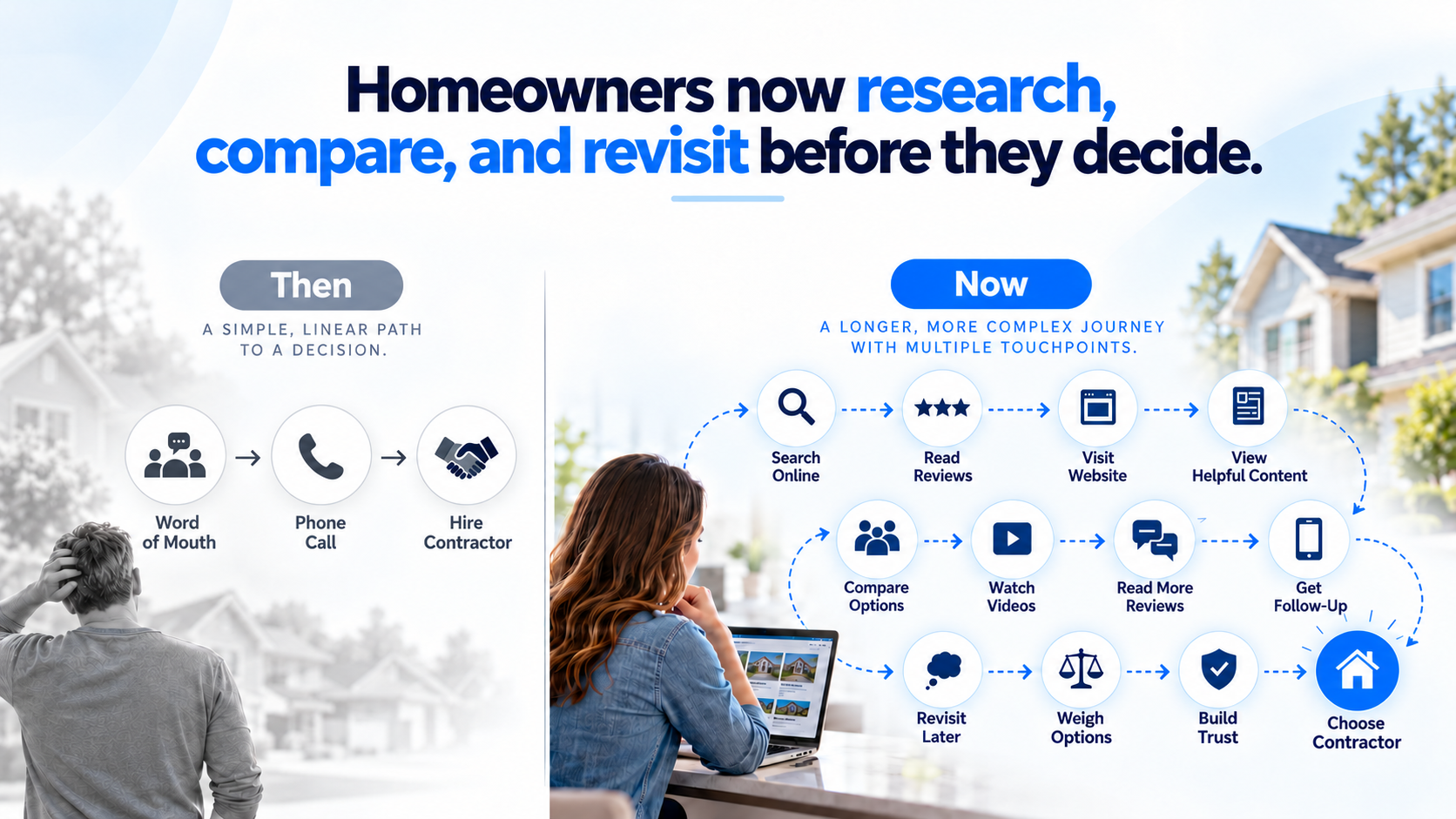
Twenty or thirty years ago, before algorithms and third party lead sources became so prevalent, a strong reputation, a little word of mouth, some local visibility, and a steady stream of referrals could carry a contractor’s business a long way.
Those things still matter.
But today, homeowners make big purchasing decisions differently.
They search online.
They read reviews.
They compare multiple contractors.
They visit websites.
They watch videos.
They research projects before calling anyone.
They involve spouses and other decision-makers.
They delay projects.
They disappear and come back months later.
They expect fast responses and clear communication.
And throughout that process, algorithms, content, follow-up, social proof, positioning, and the overall customer experience can all influence who eventually gets the job.
The sales and marketing environment became more complicated.
Most contractors never had a reason to become experts in any of this.
They became experts in roofing, remodeling, HVAC, plumbing, electrical work, landscaping, or whatever trade they built their business around.
But whether you have a formal sales and marketing department or not, the sales and marketing function still has to happen.
Someone has to create opportunities.
Someone has to build trust.
Someone has to follow up.
Someone has to help homeowners make decisions.
Someone has to understand where opportunities are being lost.
And if nobody owns those responsibilities, they usually happen inconsistently—or not at all.
There are two big levers sitting right in front of you
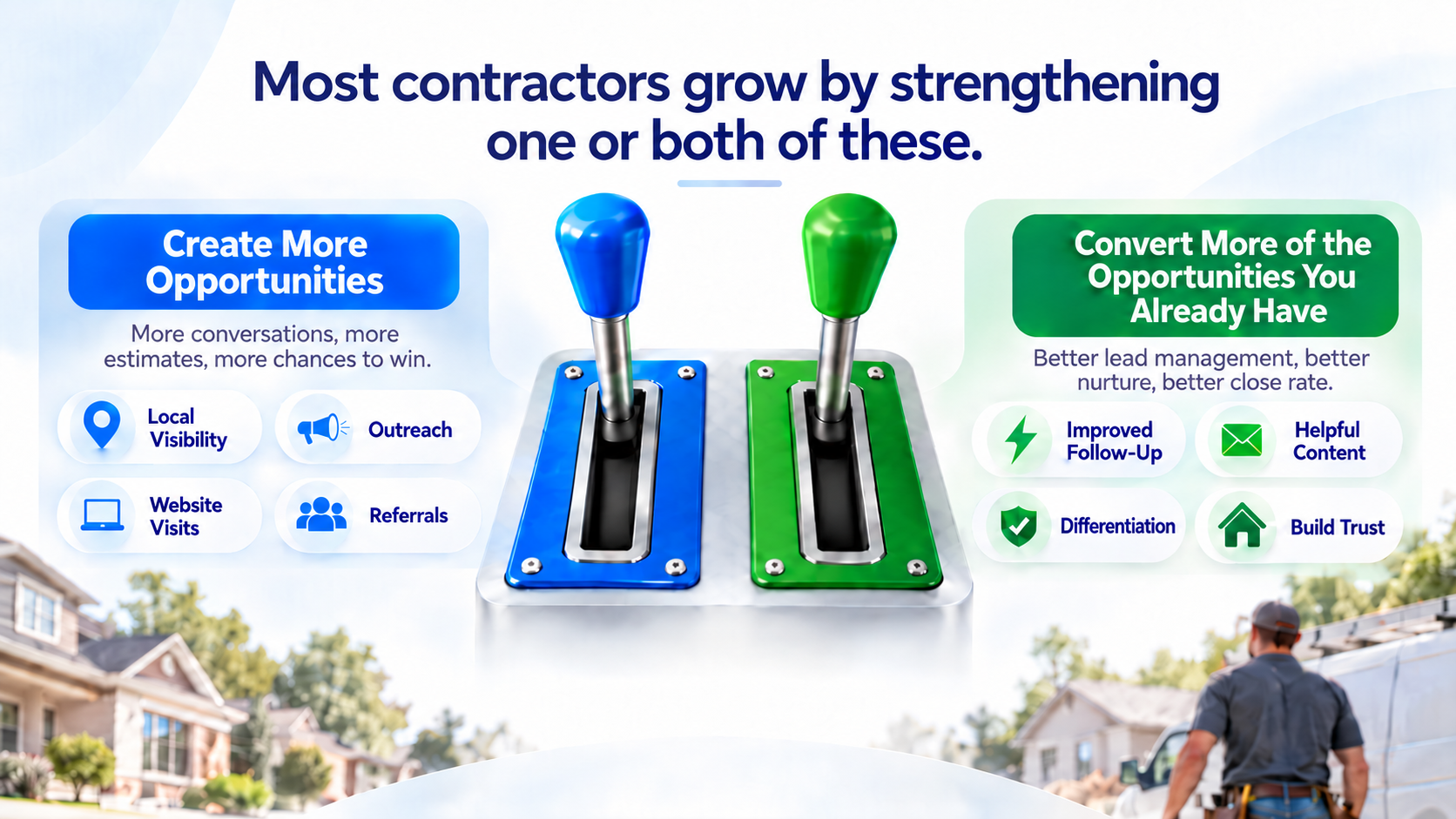
When contractors want more business, the first answer is usually:
“I need more leads.”
Maybe you do.
But generating more opportunities is only one side of the equation.
The other is converting more of the opportunities you’re already getting.
Lever One: Create More Opportunities
That can mean:
Becoming easier to find
Building a stronger local reputation
Creating useful content
Starting more conversations
Reconnecting with past customers
Generating more referrals
Building relationships in your community
Using paid lead sources more intelligently
Becoming familiar before the homeowner is ready to buy
Lever Two: Convert More of the Opportunities You Already Have
That can mean:
Responding faster
Asking better questions
Building trust earlier
Following up strategically
Keeping track of every active opportunity
Making the next step clear
Helping homeowners understand their options
Staying in touch when timing changes
Learning why opportunities are being won or lost
Both levers require sales and marketing capability.
If that expertise doesn’t already exist inside your business, you may be trying to operate two of your most important growth levers without the knowledge and experience needed to get the most out of them.
More Leads aren’t always the answer
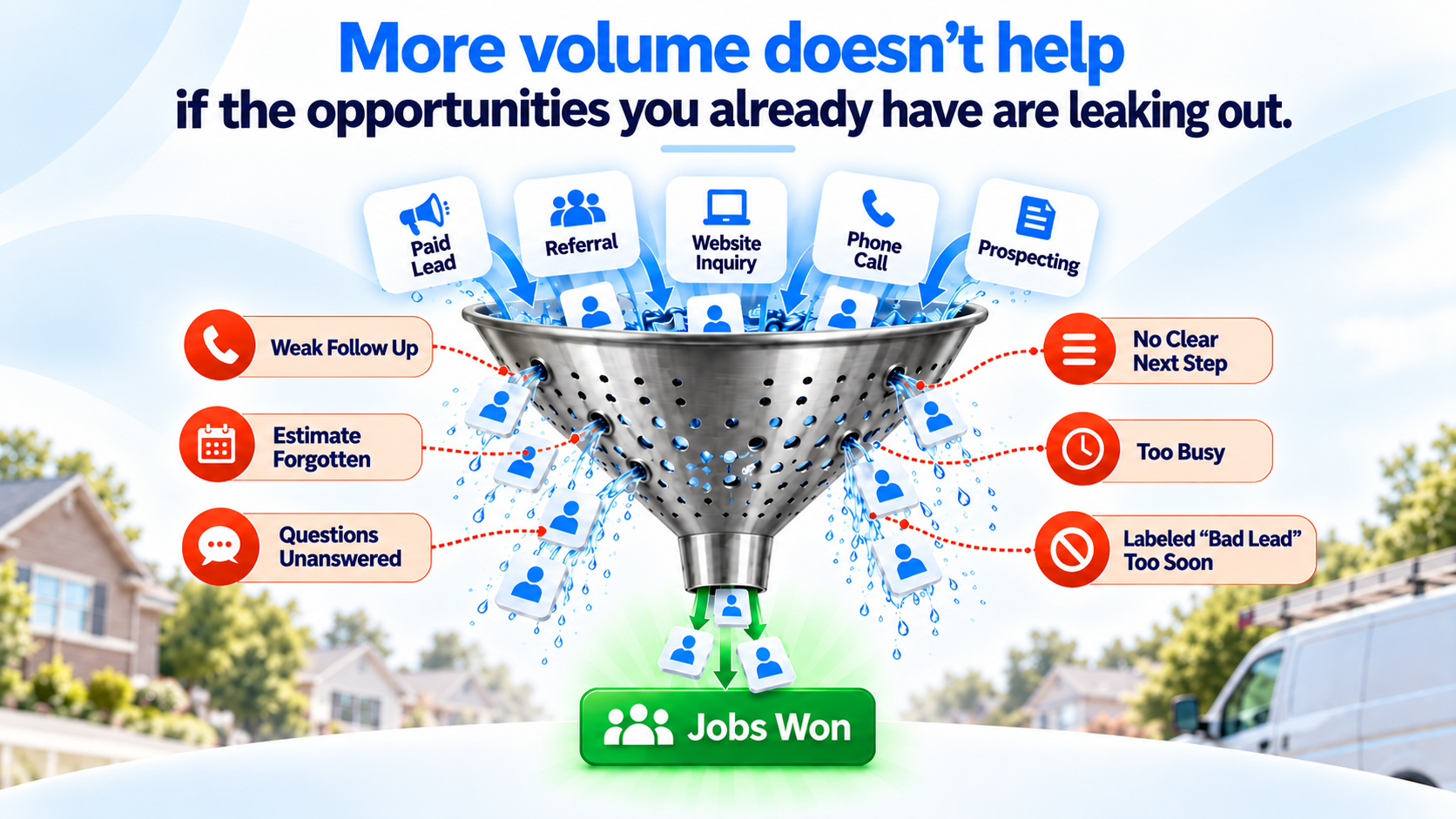
If you have a low close rate and opportunities are already falling through the cracks, pouring more leads into the top of the funnel may simply create more waste and more noise.
A perfectly legitimate homeowner can disappear because:
Nobody followed up effectively
The next step was never defined
The estimate was sent and forgotten
The homeowner wasn’t ready yet
Nobody knew who owned the opportunity
Questions went unanswered
The company became busy
The lead was labeled “bad” before anyone really understood what happened
That doesn’t mean every lost opportunity was winnable.
It means you should know the difference.
Before spending more money trying to generate additional leads, it makes sense to understand what is happening to the opportunities already entering the business.
sales & marketing is a necessary business function - Even if you don’t have a department
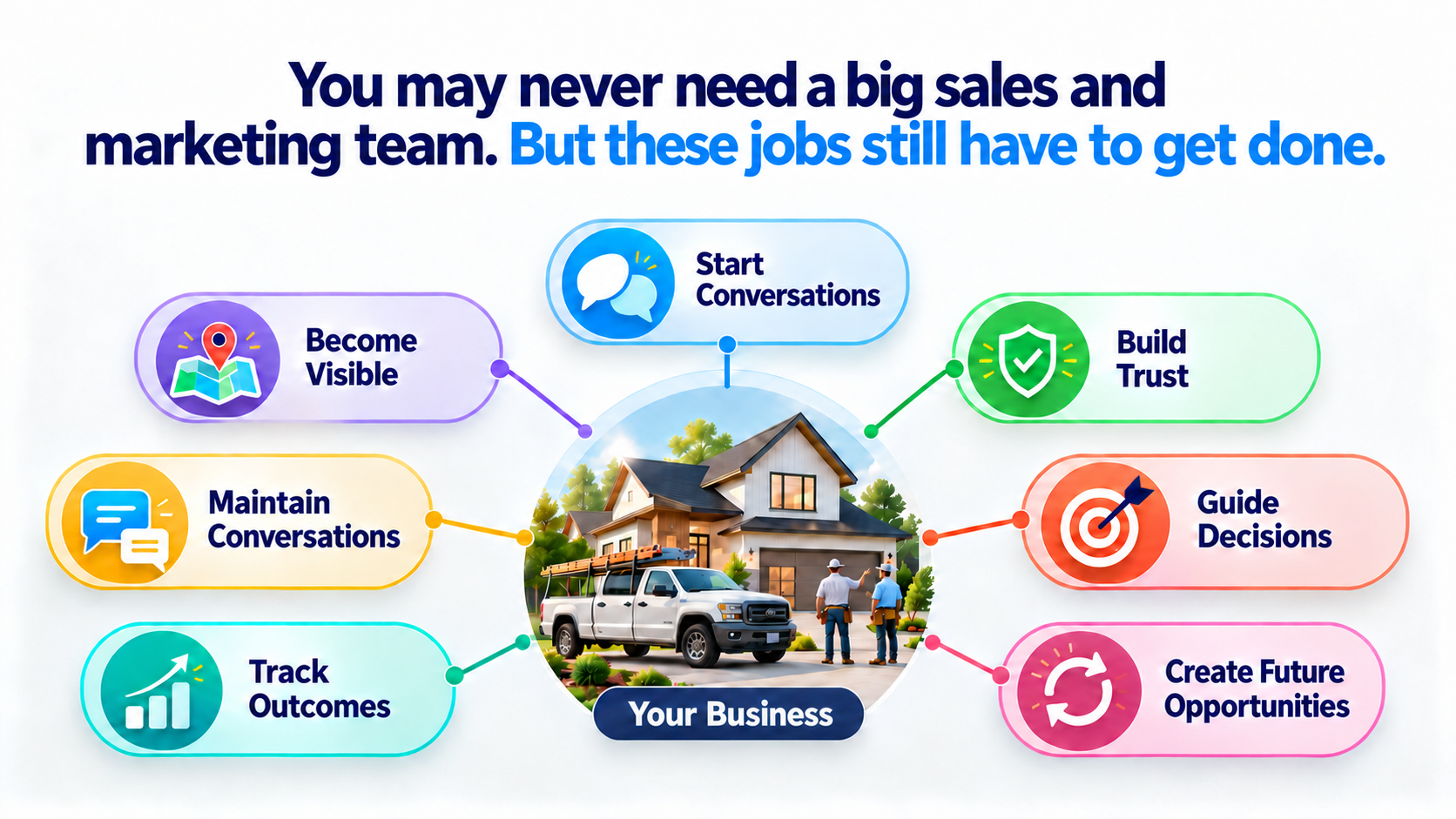
A small contractor may never need a giant corporate sales and marketing team.
But the functions still exist.
A healthy sales and marketing system has to help the business:
Start Conversations
Create new opportunities before the phone rings on its own.
Become Visible
Make it easier for the right homeowners to find and remember you.
Build Trust
Give homeowners reasons to believe you understand their problem and can solve it.
Maintain Conversations
Follow up appropriately when someone isn’t ready to make an immediate decision.
Guide Decisions
Help homeowners understand the recommendations, the process, and the next step without becoming pushy.
Track Outcomes
Know what happened to opportunities instead of relying on memory and assumptions.
Create Future Opportunities
Turn satisfied customers into reviews, referrals, repeat work, and stronger proof.
Those are not isolated marketing tactics.
They are parts of one system.
The Contractor Lead Machine
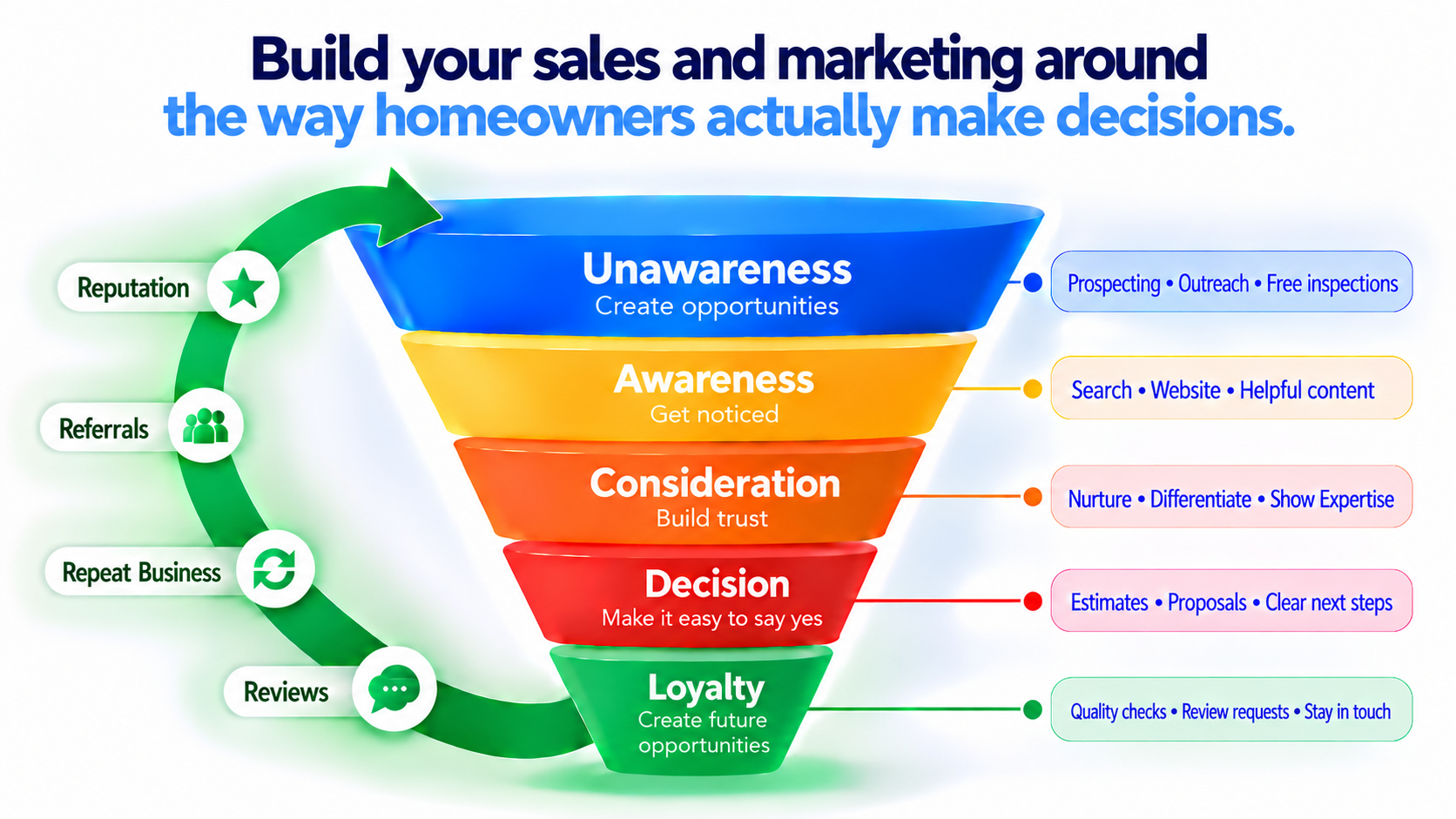
I call that system the Contractor Lead Machine.
It is built around the way homeowners move through a high-consideration buying decision.
Unawareness
At this stage, the homeowner may eventually need your service but isn’t actively looking yet.
This is where visibility, reputation, content, referrals, local relationships, and proactive outreach can begin the conversation.
Awareness
At this stage, the homeowner recognizes that something needs fixing or something needs to be improved and begins paying attention to possible solutions.
Can they find you?
Do you look credible?
Do you respond promptly?
Consideration
At this stage, the homeowner begins learning about the problem or project, comparing service providers, asking questions, and deciding who they trust.
This is where many opportunities slow down.
Good follow-up, useful content, clear communication, and consistent next actions matter enormously.
Decision
At this stage, the project becomes more immediate.
The homeowner is evaluating scope, price, trust, timing, risk, and competing options.
Your job isn’t to pressure them.
It’s to make the decision easier to understand.
Loyalty
At this stage, the job may be complete, but the relationship doesn’t have to come to an end.
A satisfied customer can create:
Reviews
Referrals
Repeat business
Testimonials
Future conversations
Proof that makes the next homeowner easier to win
The goal isn’t to rebuild everything at once.
It’s to understand the whole Lead Machine well enough to identify the vital few improvements most likely to make a meaningful difference.
Explore the Contractor Lead Machine
You don’t need to become a pushy salesperson
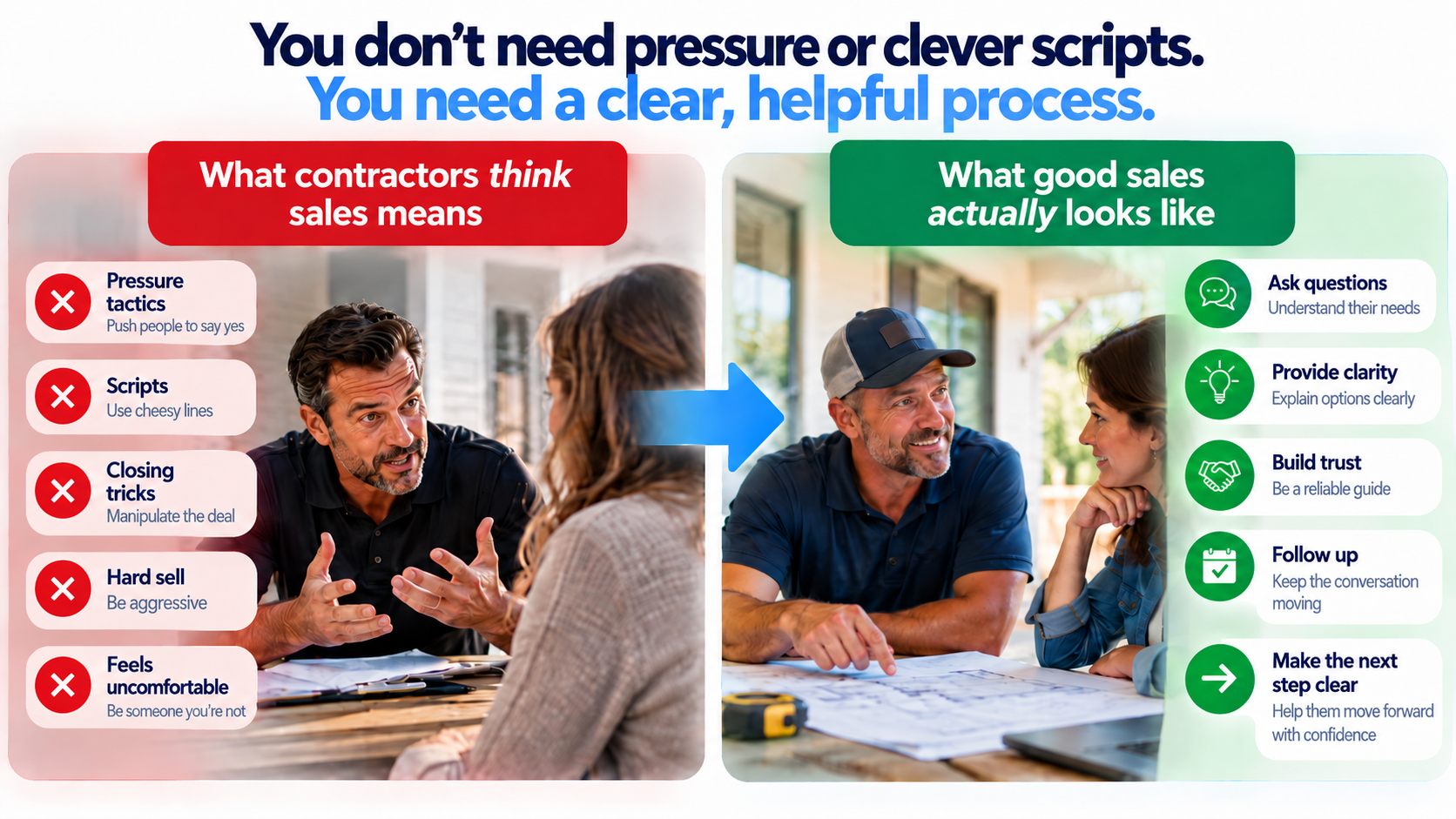
You don’t need cheesy closing techniques.
You don’t need aggressive scripts.
You don’t need to pressure homeowners into making decisions they aren’t ready to make.
And you don’t need to turn your company into a giant marketing operation.
Good sales and marketing is much simpler than that.
Start more quality conversations.
Understand what homeowners actually need.
Maintain the right conversations over time.
Make the next step clear.
Measure what happens.
Fix the places where opportunities are consistently getting lost.
That is what a reliable system is supposed to help you do.
Why work with me?
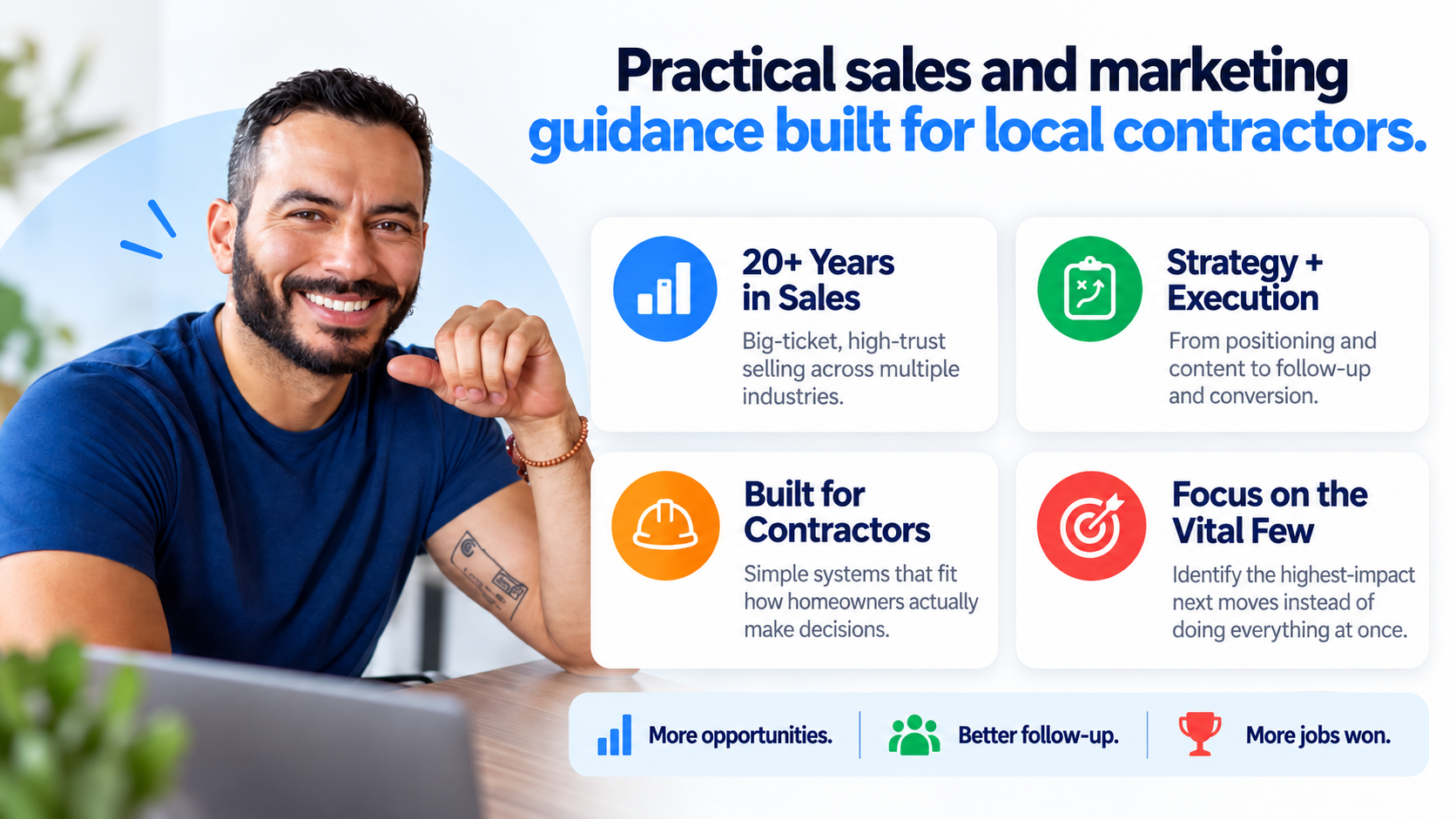
I’m JC Amaya.
I’ve spent nearly 20 years selling big-ticket, high-consideration services across industries including financial services, software, SaaS, digital marketing, and consulting.
Those experiences taught me how people behave when the decision matters.
They research.
They compare.
They hesitate.
They involve other people.
They worry about making the wrong decision.
They sometimes disappear.
They sometimes come back.
And they are far more likely to move forward when the process creates clarity and trust instead of pressure.
Those principles transfer naturally to contractors because homeowners are often making expensive, disruptive, high-stakes decisions about their homes.
You spent your career becoming good at your trade.
I spent mine learning how to create opportunities, build trust, maintain conversations, and help people make high-consideration buying decisions.
I help contractors bring those skills into their businesses.
Ways to work
with me
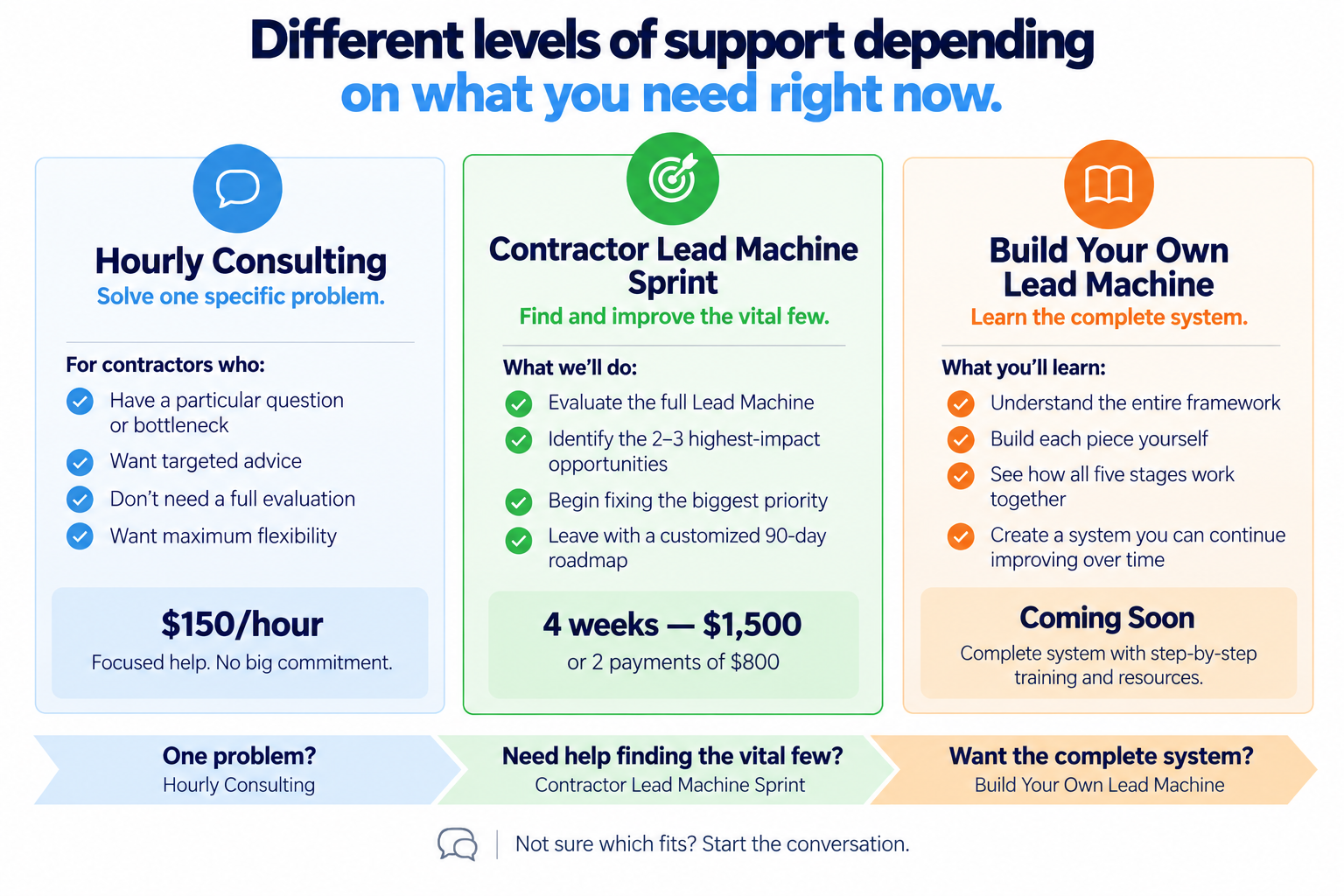
You don’t need to commit to a giant engagement to get help.
Choose the level that makes sense for where your business is right now.
Hourly Consulting
Have a specific sales or marketing problem you want to work through?
Book time with me and we’ll dig into it together.
This is a good fit when you want practical guidance without committing to a larger engagement.
Contractor Lead Machine Sprint
A focused four-week engagement designed to evaluate how your business generates, handles, follows up with, and converts opportunities.
We identify the biggest leaks, strengthen the best opportunities, and build a customized 90-day roadmap around the few improvements most likely to matter.
Explore the Contractor Lead Machine Sprint
Build Your Own Lead Machine
Coming Soon
A practical sales and marketing system built specifically for small, local contractors who want to create, nurture, follow up with, convert, and retain more opportunities without depending entirely on expensive third-party lead platforms.
Learn About Build Your Own Lead Machine
Not ready to work together yet?
That’s fine.
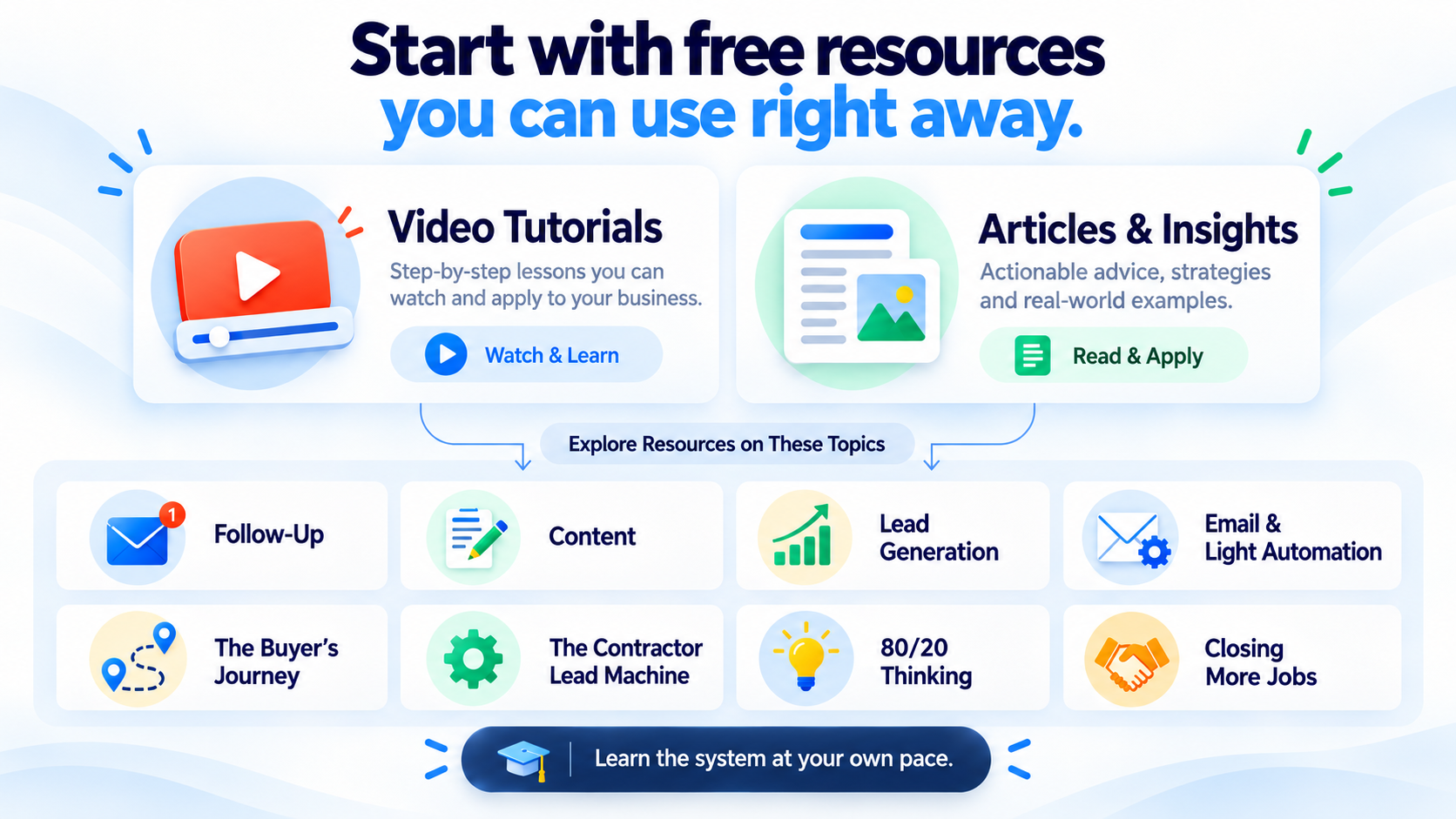
Start with the free resources.
I publish practical videos and articles about:
Contractor sales
Lead generation
Follow-up
Homeowner decision-making
Reviews and referrals
Sales and marketing systems
Lead-source evaluation
Opportunity tracking
80/20 improvement
Building a business that depends less on luck
Each resource is designed to help you understand one part of the Lead Machine and give you something useful you can apply to your business.
Start the conversation
You don’t need to know exactly what service you need.
You don’t need to have your sales process figured out.
And you don’t need to prepare some elaborate business presentation.
Tell me a little about your company, what you’re trying to improve, or where things seem to be getting stuck.
We’ll start there.