
The Contractor Lead Machine

A trade business doesn’t grow because of one marketing tactic, one lead source, or one great script.
It grows because a series of things happen well enough, consistently enough, for opportunities to become customers.
Someone has to become aware of you.
They have to trust you enough to start a conversation.
That conversation has to be handled well.
Follow-up has to happen when the timing is not immediate.
The homeowner has to become comfortable enough to make a decision.
And after the job is complete, that relationship can create reviews, referrals, repeat business, and stronger credibility with the next homeowner.
I call that entire process the Contractor Lead Machine.
It is a practical way to understand how your business creates opportunities, develops them, converts them, and turns completed jobs into future business.
Your Sales & Marketing Problems May Be More Connected Than They Look
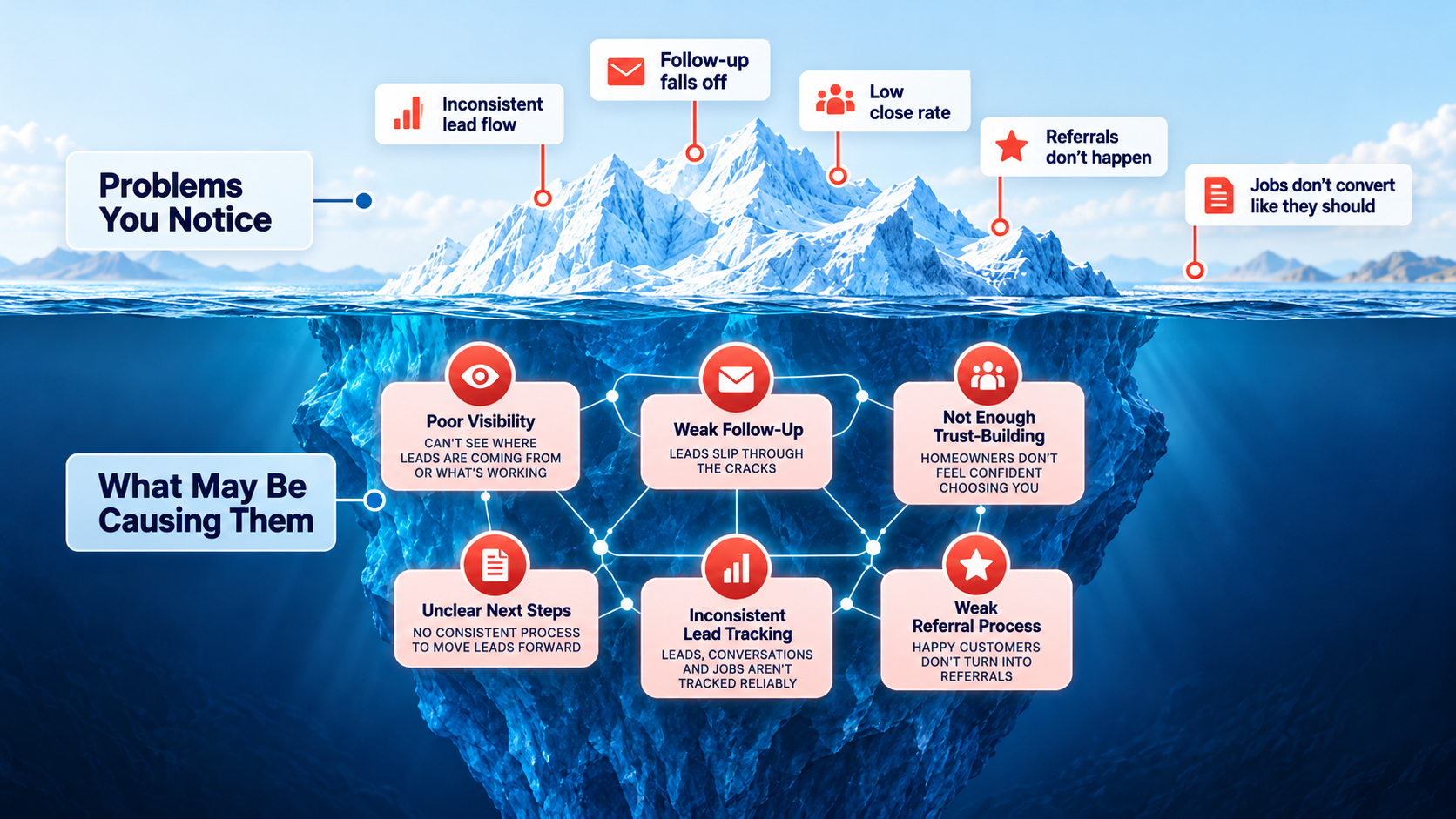
Contractors often experience sales and marketing problems as separate issues.
“We need more leads.”
“Our leads are terrible.”
“People keep disappearing after estimates.”
“We don’t follow up enough.”
“I don’t know which marketing is actually working.”
“We get plenty of happy customers, but hardly any reviews.”
Those may sound like completely different problems.
But they can also be symptoms of weaknesses at different points in the same system.
That is why I like looking at the whole Lead Machine first.
It gives you a way to step back from the individual tactics and ask a more useful question:
Where are opportunities being created, developed, lost, converted, and recycled into future business?
Once you can see the entire process, it becomes much easier to figure out where your attention belongs.
Two of the Biggest Growth Levers Are Usually Right in Front of You
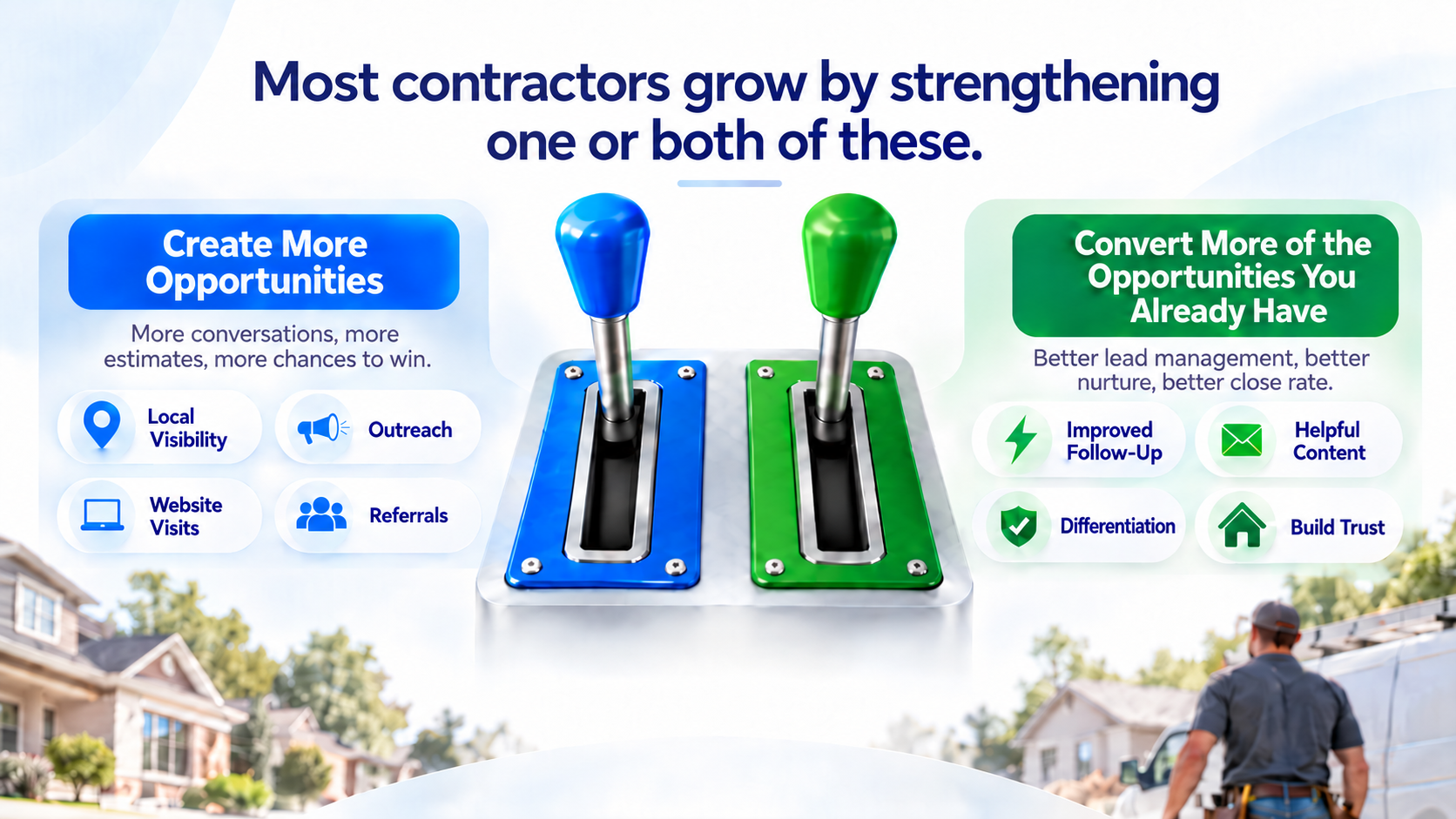
If you want to win more jobs, two of the most obvious levers available to almost any contractor are:
Create more opportunities.
and
Convert more of the opportunities you already have.
The Contractor Lead Machine covers both.
The early stages help create awareness, familiarity, and conversations.
The middle stages help maintain those conversations and build enough trust for the homeowner to keep moving.
The later stages help the homeowner make a decision and turn successful work into future opportunity.
That is important because more leads are not always the answer.
If good opportunities are already leaking out of the system, adding more volume may simply create more waste.
And if your existing process converts well but too few new conversations are entering the business, then opportunity creation may deserve more attention.
You need to understand which lever matters most right now.
Start With the Way Homeowners Actually Make Decisions
The Contractor Lead Machine is built around a simple idea:
Your sales and marketing process should reflect the way homeowners actually make high-consideration buying decisions.
Hiring a contractor for a major project is rarely an impulse purchase.
Homeowners may research for weeks or months.
They may ask friends.
Read reviews.
Watch videos.
Visit several websites.
Speak with multiple contractors.
Compare scopes that are not actually comparable.
Talk to a spouse.
Wait for financing.
Delay the project.
Go silent.
Come back later.
The journey is rarely perfectly linear.
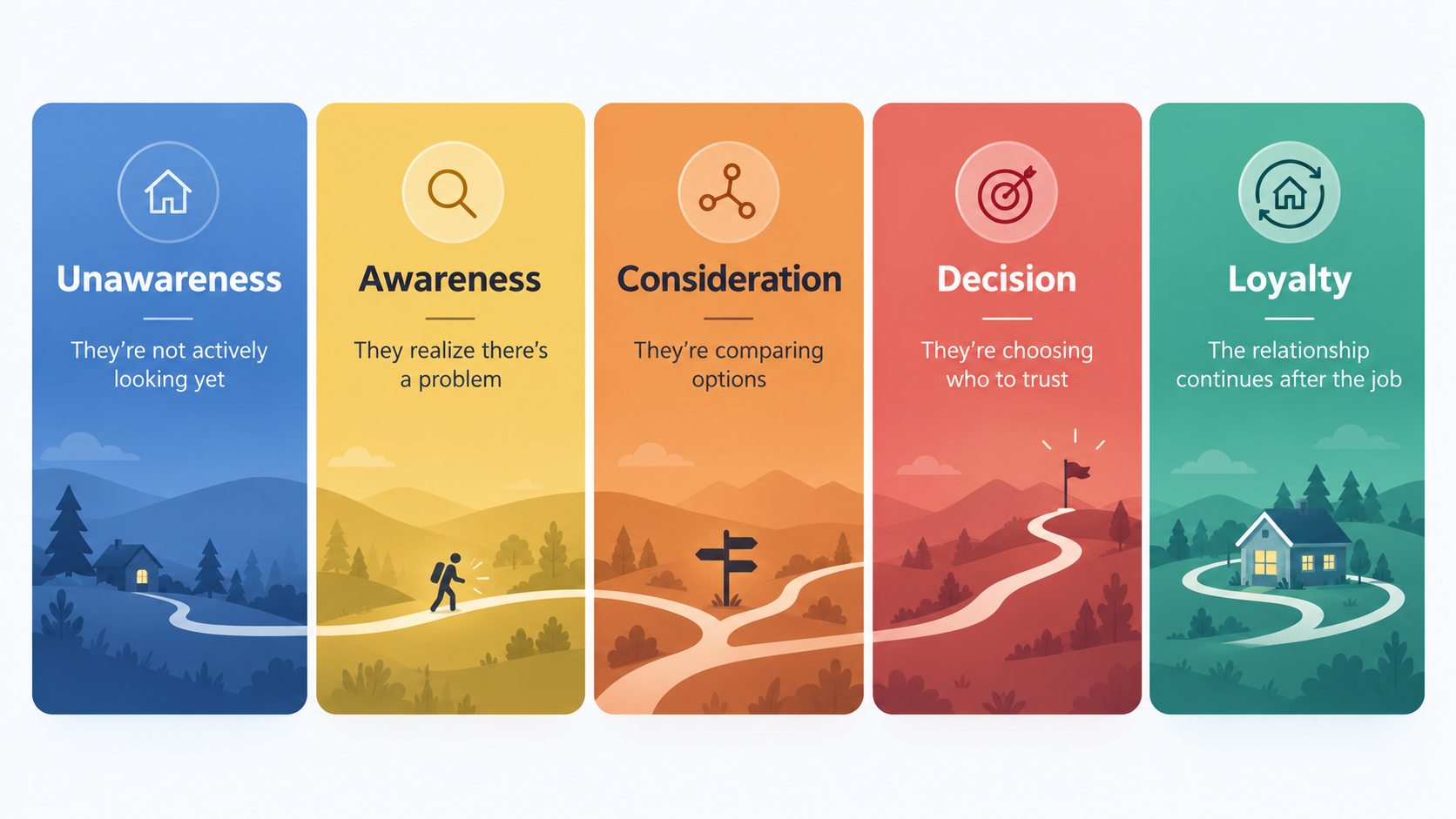
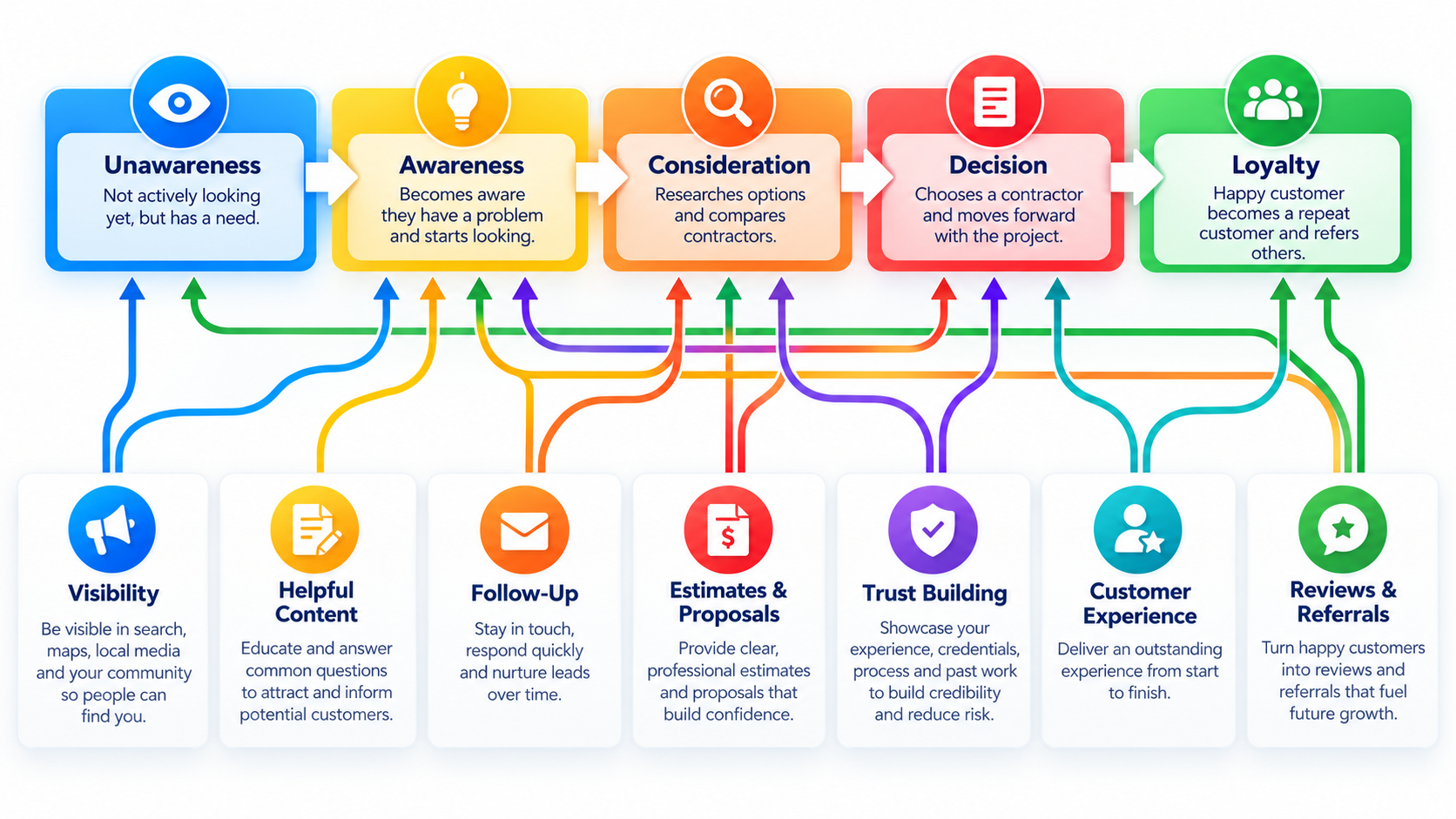
But it generally moves through five useful stages:
Unawareness → Awareness → Consideration → Decision → Loyalty
Stage 1 — Unawareness
Before a homeowner is actively looking for a contractor, there may already be an opportunity to become familiar.
Maybe they see your trucks in the neighborhood.
A friend mentions your company.
They watch one of your videos.
You introduce yourself while working nearby.
A past customer mentions you.
They see useful information you published.
The homeowner may not need you today.
That does not mean the interaction has no value.
This stage is about creating visibility, familiarity, and future conversations before the buying decision becomes urgent.
The contractor who becomes known before the homeowner starts comparing companies has an advantage over the contractor who first appears when five other estimates are already being requested.
Stage 2 — Awareness
Something changes.
The homeowner recognizes a need.
Now they are paying attention.
Can they find you?
Does your company look credible?
Do your reviews support the impression you want to create?
Does your website clearly explain what you do?
Do you respond when they reach out?
Does beginning a conversation feel easy?
This is where first impressions matter enormously.
A contractor can do excellent work and still lose an opportunity before ever getting the chance to demonstrate it.
Stage 3 — Consideration
Now the homeowner is evaluating.
They may be learning about the project, comparing companies, thinking about cost, assessing risk, and trying to determine who they trust.
This is often where the buying process slows down.
And it is one of the places where contractors frequently lose good opportunities.
The homeowner may not be ready today.
That does not necessarily mean they are not interested.
They may need more information.
They may be waiting.
They may need to speak with someone else.
They may simply have other priorities demanding attention.
This is where things like follow-up, useful content, clear communication, trust-building, and defined next actions become especially important.
Stage 4 — Decision
Eventually, some opportunities become more immediate.
Now the homeowner is seriously evaluating questions such as:
What exactly am I buying?
Why does one estimate cost more than another?
Who do I trust?
What happens if something goes wrong?
When can the work begin?
Who will actually be in my home?
Which option makes the most sense?
Good sales is not about forcing that decision.
It is about helping the homeowner understand it.
A strong contractor sales process reduces confusion, addresses legitimate concerns, clarifies the next step, and makes it easier for the homeowner to move forward confidently.
Stage 5 — Loyalty
The project is finished.
For many businesses, that is where the sales and marketing process ends.
It should not.
A satisfied customer may become:
A reviewer.
A referral source.
A repeat customer.
A testimonial.
A case study.
A source of before-and-after proof.
Someone who introduces you to a neighbor.
Someone who remembers you three years later when another project appears.
Loyalty helps feed the front of the Lead Machine.
The end of one customer journey can become the beginning of several new ones.
The Contractor Lead Machine Connects Those Stages
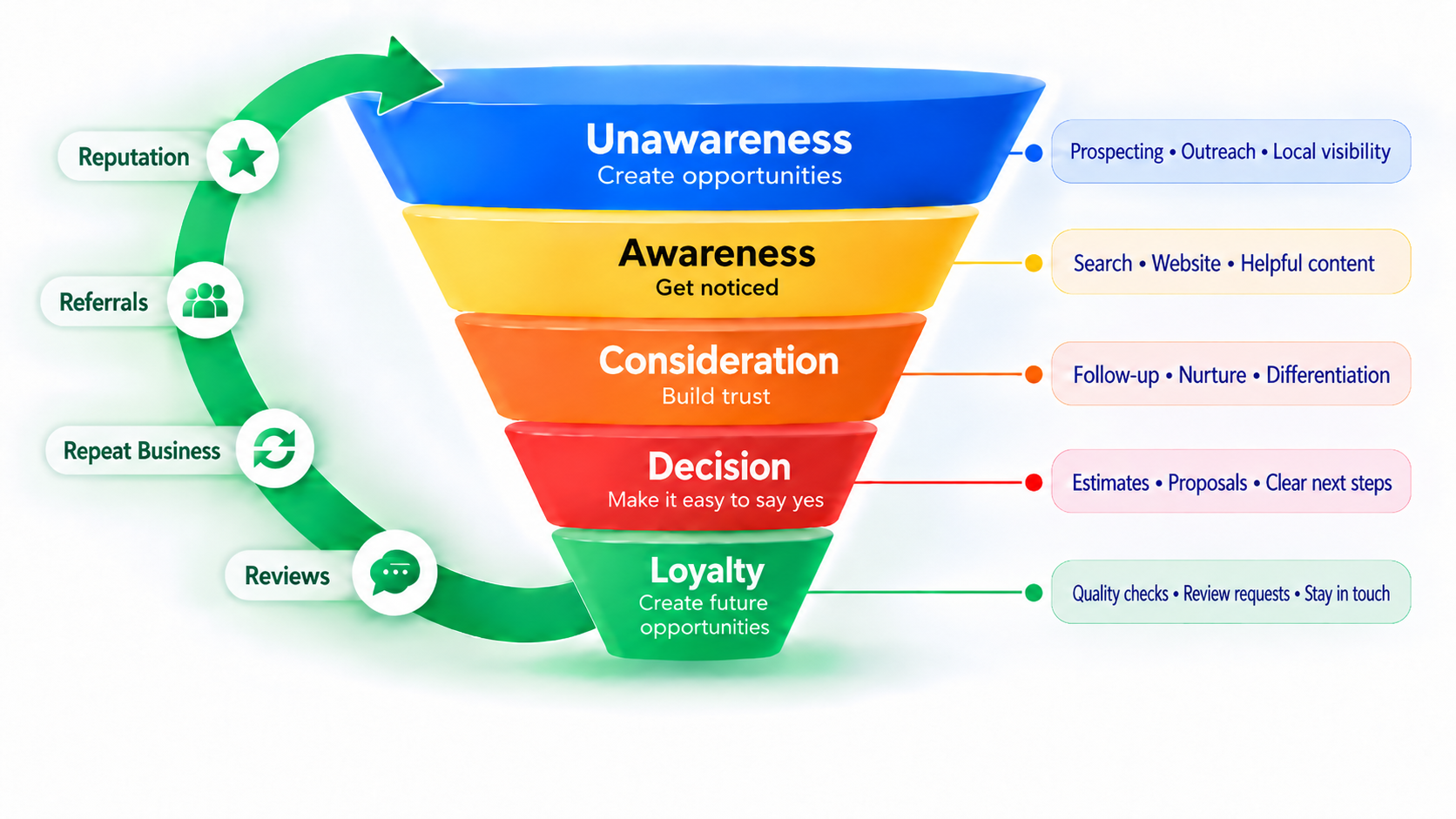
The Buyer’s Journey describes what is happening as the homeowner moves toward and beyond a purchase.
The Contractor Lead Machine asks:
What should the business be doing while that journey is happening?
The exact tactics will vary from company to company.
But the basic responsibilities do not disappear.
The business has to create visibility.
Start conversations.
Respond to opportunities.
Build trust.
Follow up.
Maintain useful contact.
Help homeowners make decisions.
Track outcomes.
And turn successful projects into future opportunity.
Whether you have a formal sales department or not, somebody has to own those functions.
It’s All Conversations
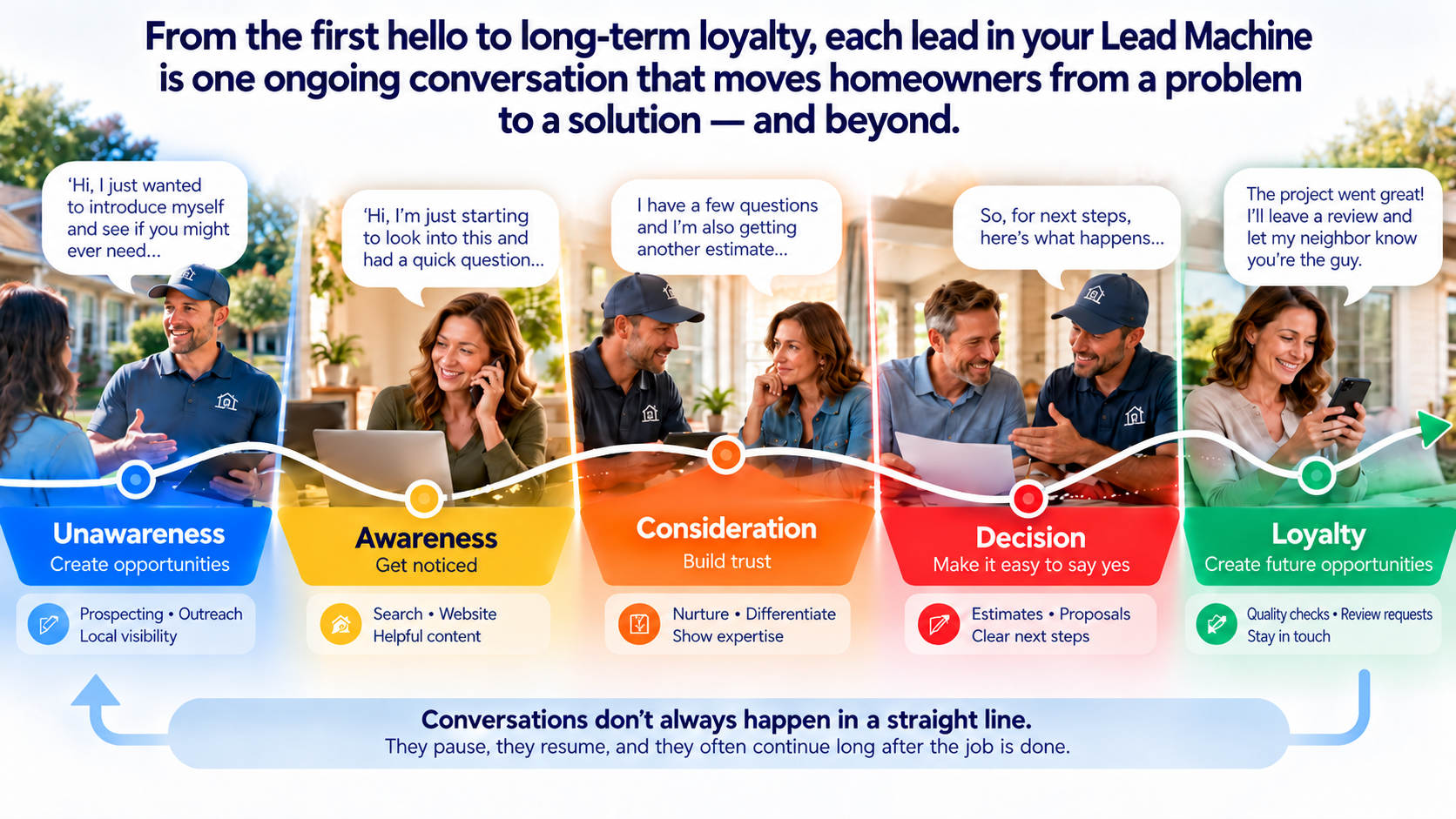
The stages are useful because they help organize the process.
But underneath all of them is an even simpler idea:
It’s all conversations.
Prospecting starts conversations.
Marketing helps create and support conversations.
Follow-up maintains conversations.
Sales helps the right conversations reach a decision.
Loyalty allows successful conversations to create future ones.
And those conversations do not always move continuously.
Some are active.
Some pause.
Some resume later.
Some belong in long-term nurture.
Some are not a fit.
Some end.
The goal is not to keep every lead alive forever.
The goal is to understand where the conversation stands and know what should happen next.
A Lead Machine should prevent valuable conversations from being forgotten, mishandled, or abandoned simply because nobody had a reliable process for continuing them.
Every Transition Can Leak
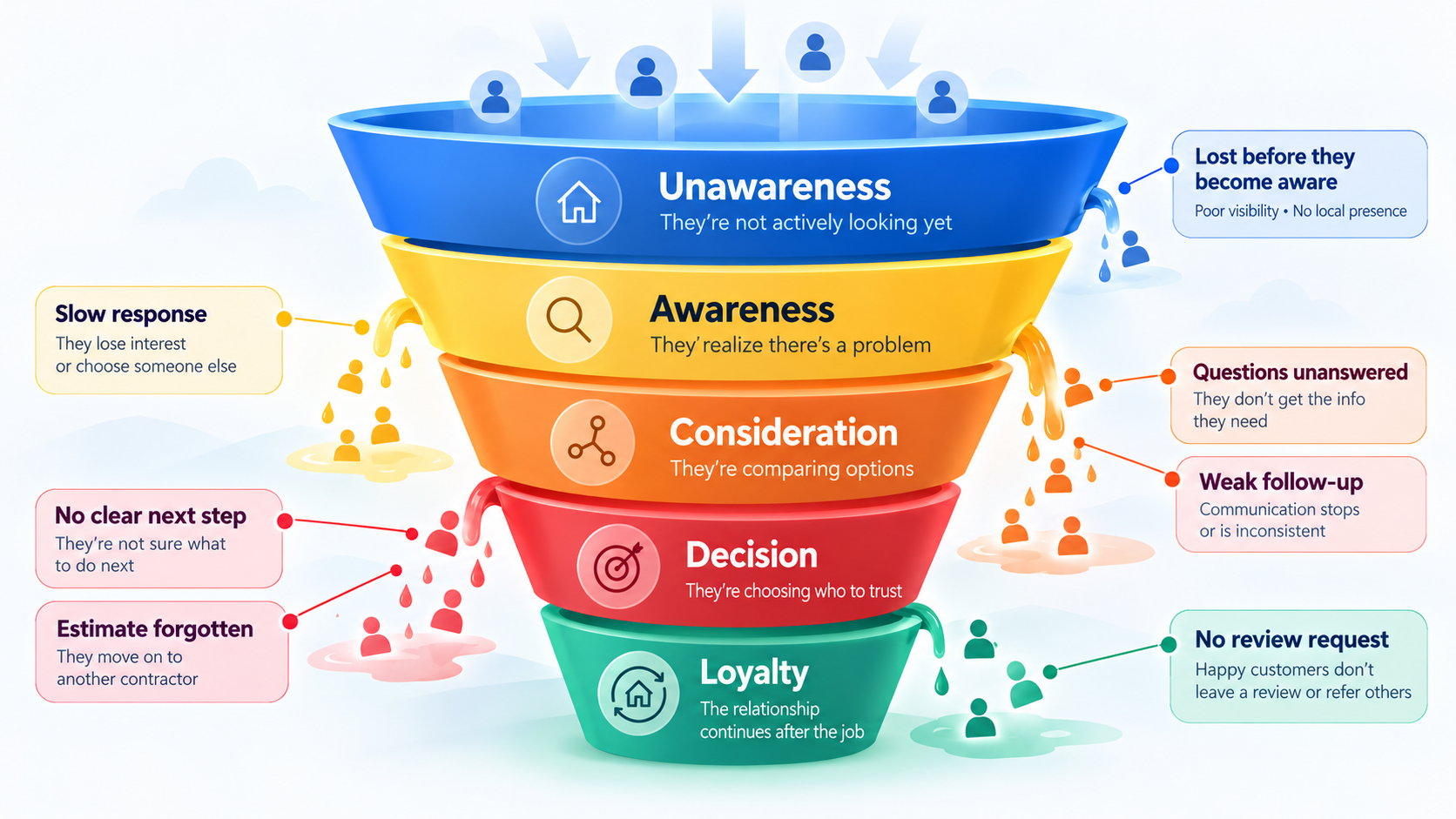
A contractor may have strong individual pieces and still lose opportunities between them.
A homeowner sees your company but never reaches out.
A lead comes in but receives a slow response.
An appointment happens, but nobody records what matters.
An estimate gets sent with no defined next step.
A homeowner delays the project and disappears from everyone’s radar.
A salesperson assumes the lead was bad because they stopped answering.
A completed customer is happy but never gets asked for a review.
The problem is often not one giant failure.
It is a series of small leaks.
And over enough opportunities, small leaks become expensive.
Why Follow-Up Deserves So Much Attention
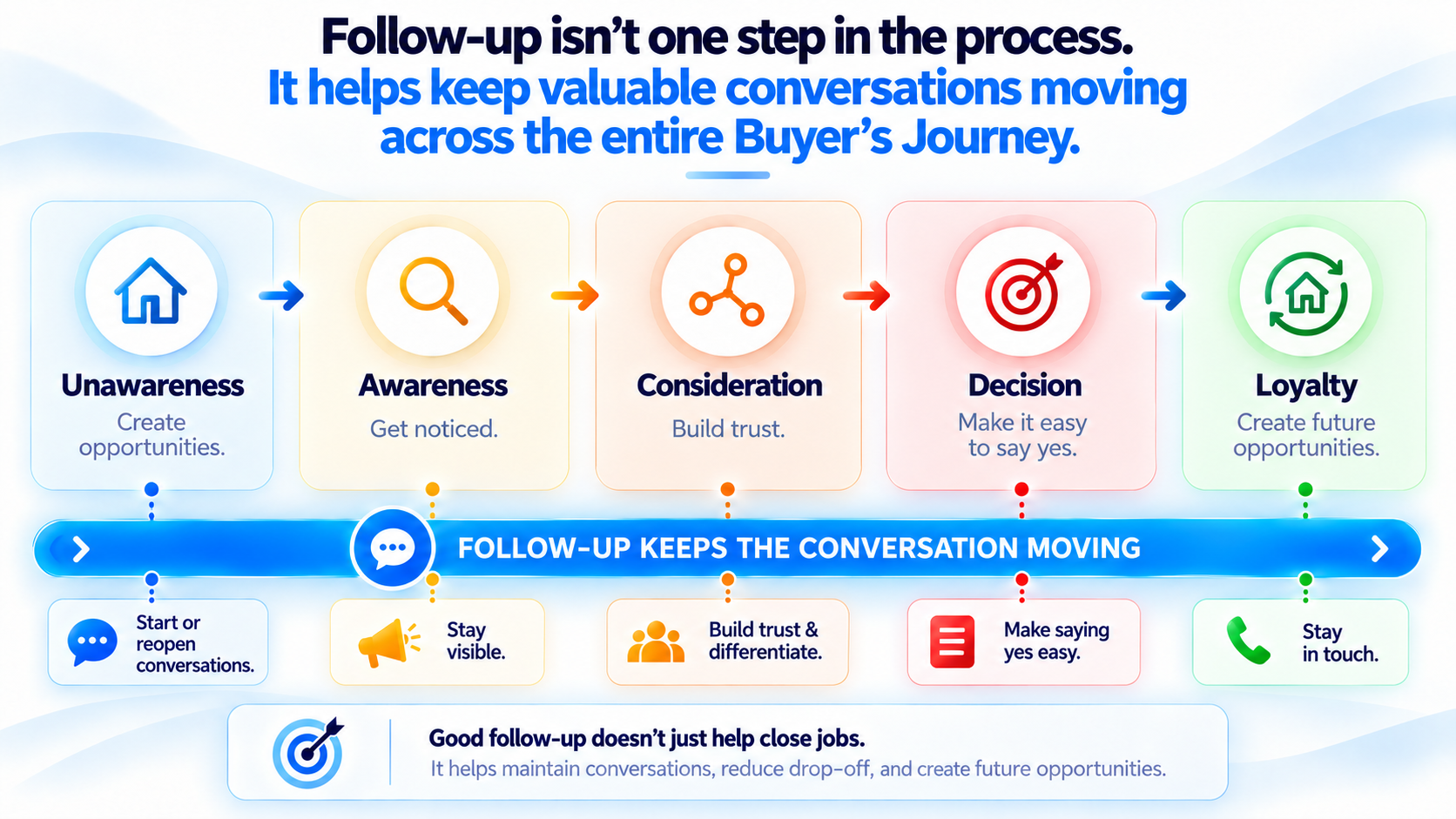
Follow-up is one of the most common places those leaks appear.
Not because every homeowner needs to be chased.
Quite the opposite.
High-consideration buyers often need time.
They compare.
They think.
They get distracted.
They wait on financing.
They talk to family, friends, coworkers.
Their priorities change.
The project gets delayed.
Then something happens and the need becomes urgent again.
Good follow-up means the business has a way to remember that conversation and respond appropriately to where the homeowner actually is at any given moment.
Sometimes that means calling tomorrow.
Sometimes next week.
Sometimes three months from now.
Sometimes it means sending useful information instead of asking for a decision.
Sometimes it means recognizing that the opportunity is no longer worth pursuing.
The point is not persistence for its own sake.
The point is intentionality.
A good opportunity should not disappear simply because nobody knew what to do next.
The Five Stages Need a Strong Foundation
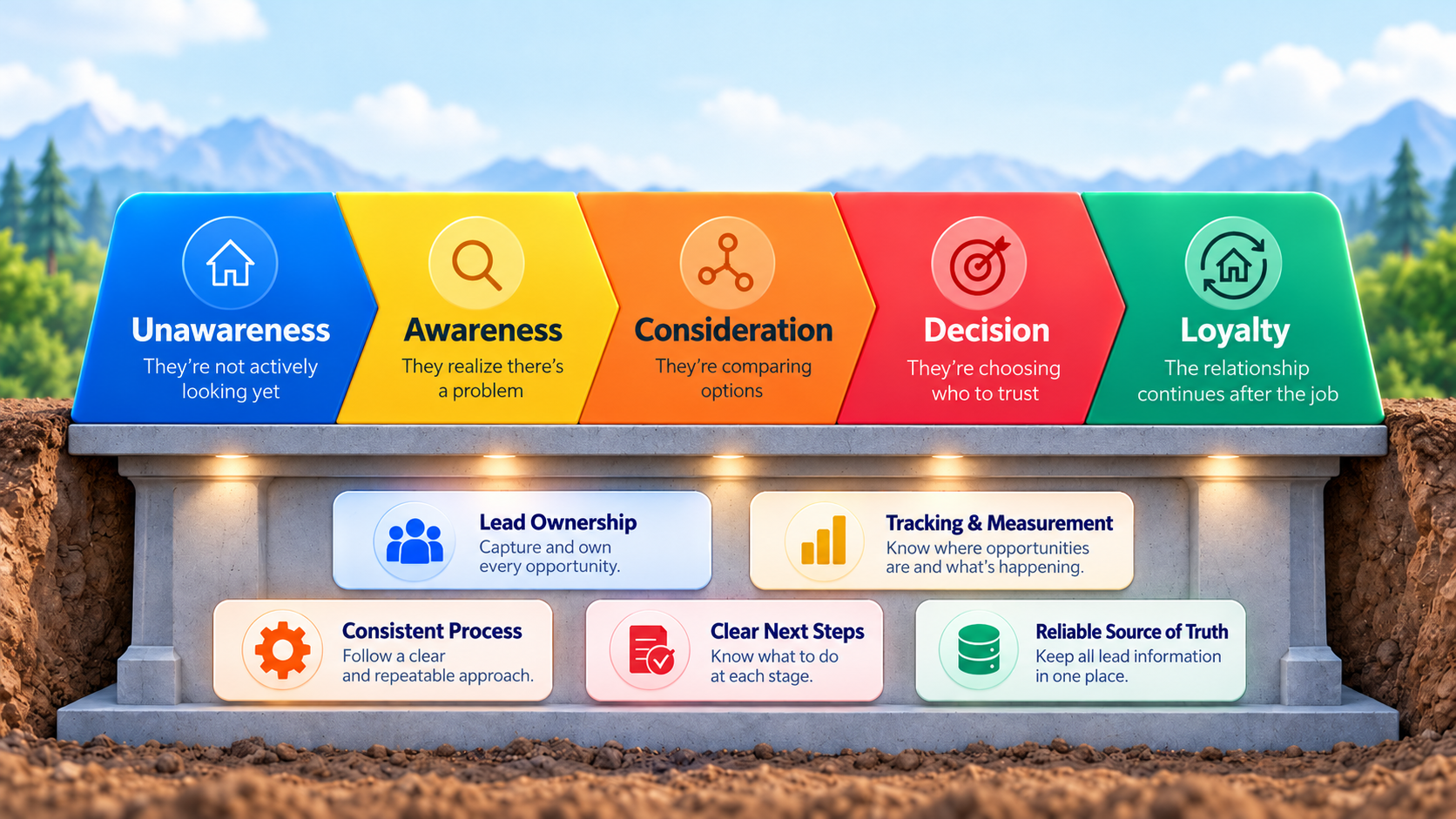
The visible stages of the Lead Machine matter.
But underneath them are the things that make the system dependable.
A business may technically have a follow-up process.
But does anyone clearly own it?
Does everyone use the same process?
Is the next action recorded somewhere reliable?
Can somebody else take over if the usual person is unavailable?
Can you tell whether the process is working?
Does it survive when the business gets slammed?
The foundations of a reliable Lead Machine include things like:
Clarity — people understand what should happen.
Consistency — the process is actually followed.
Ownership — someone is accountable.
Measurement — outcomes are visible.
Resilience — the system survives normal business pressure.
Clear next actions — active opportunities are not left floating.
One usable source of truth — important information does not live only in someone’s memory.
A sophisticated tool can’t compensate for a process nobody understands.
And a basic spreadsheet with clear ownership may outperform an expensive CRM nobody reliably uses.
The Pieces Should Reinforce Each Other
A real system becomes more powerful because the individual parts support one another.
Useful content can help a homeowner understand a problem.
That builds familiarity and trust.
Greater trust can make the first conversation easier.
A better conversation can produce a more relevant recommendation.
A clearer recommendation can make follow-up easier.
Better follow-up can improve conversion.
A completed job can produce a review.
That review can strengthen your website.
A stronger website can make the next homeowner trust you faster.
A happy customer can produce a referral.
That referral begins another conversation.
That is the machine.
Not a collection of random marketing tactics.
A set of connected activities that become more valuable because they work together.
Seeing the Whole System Does Not Mean Fixing Everything
This is where 80/20 thinking becomes important.
Once contractors see all the things they could improve, the temptation is to start ten projects at once.
That is usually a mistake.
The purpose of understanding the complete Lead Machine is not to rebuild the whole thing tomorrow.
It is to make better decisions about what deserves attention.
My core principle is:
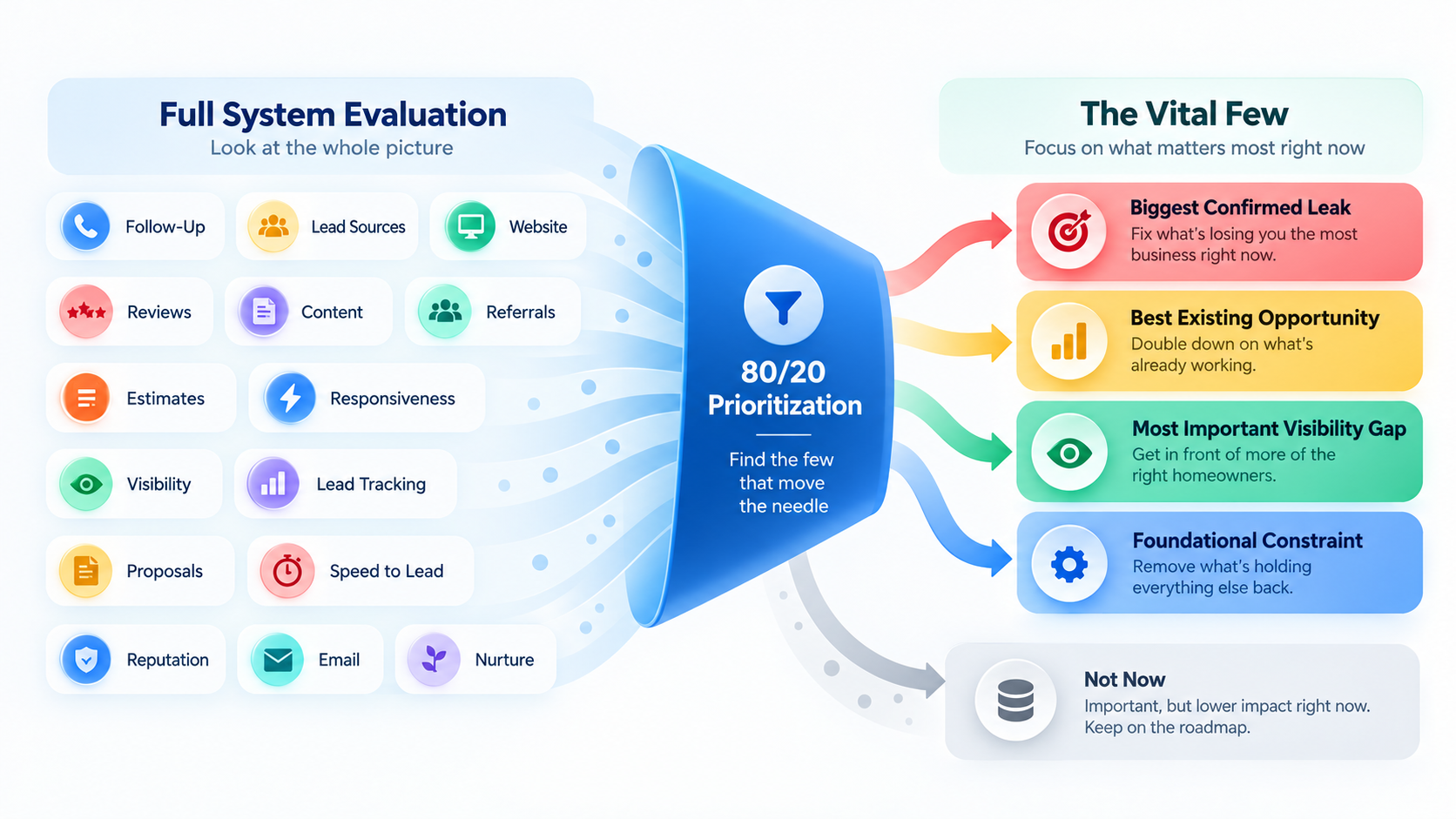
Evaluate broadly enough to understand the system. Prioritize narrowly enough to improve it.
When I evaluate a sales and marketing system, I am usually looking for a few different things:
The biggest confirmed leak.
The best existing opportunity.
The most important visibility gap.
A foundational constraint that may be preventing other improvements from working.
And just as importantly:
The things that belong on the Not-Now list.
Because every good idea does not need to become this week’s project.
A Simple Lead Machine Self-Audit
You can begin evaluating your own system without buying anything.
Take the last ten legitimate opportunities that entered your business and work backward through what happened.
For each one, try to answer:
Where did the opportunity come from?
How quickly did someone respond?
Who owned the conversation?
What happened after the first contact?
Was there a clearly defined next action?
Was follow-up recorded?
Did the homeowner receive an estimate?
What happened after the estimate?
Was the opportunity won, lost, delayed, or simply unknown?
If it was lost, do you know why?
If it became a customer, did you ask for a review or referral?
Is that customer part of any future follow-up process?
You may find obvious problems.
But pay particular attention to the questions you cannot answer.
Those visibility gaps often matter just as much as the known problems.
You cannot reliably improve what you cannot see.
You Don’t Need a Perfect Lead Machine
A small contractor does not need the infrastructure of a Fortune 500 company.
You don’t need fifty marketing tools.
You don’t need twenty dashboards.
You don’t need to automate every interaction.
And you don’t need to become a professional marketer.
You need enough structure to make the important parts of the business reliable.
A good Lead Machine should be:
Understandable.
Usable.
Measurable.
Sustainable.
And resilient enough to survive a busy week.
The goal is not complexity.
The goal is to create more good opportunities, handle them more effectively, and lose fewer of them because the business lacked a reliable process.
The Contractor Lead Machine in One Sentence
If I had to reduce the entire system to one idea, it would be this:
Create more quality conversations, maintain the right conversations effectively, help homeowners move forward when the timing is right, and allow successful customer relationships to create future conversations.
Everything else exists to make that happen more reliably.
Want to Go Deeper?
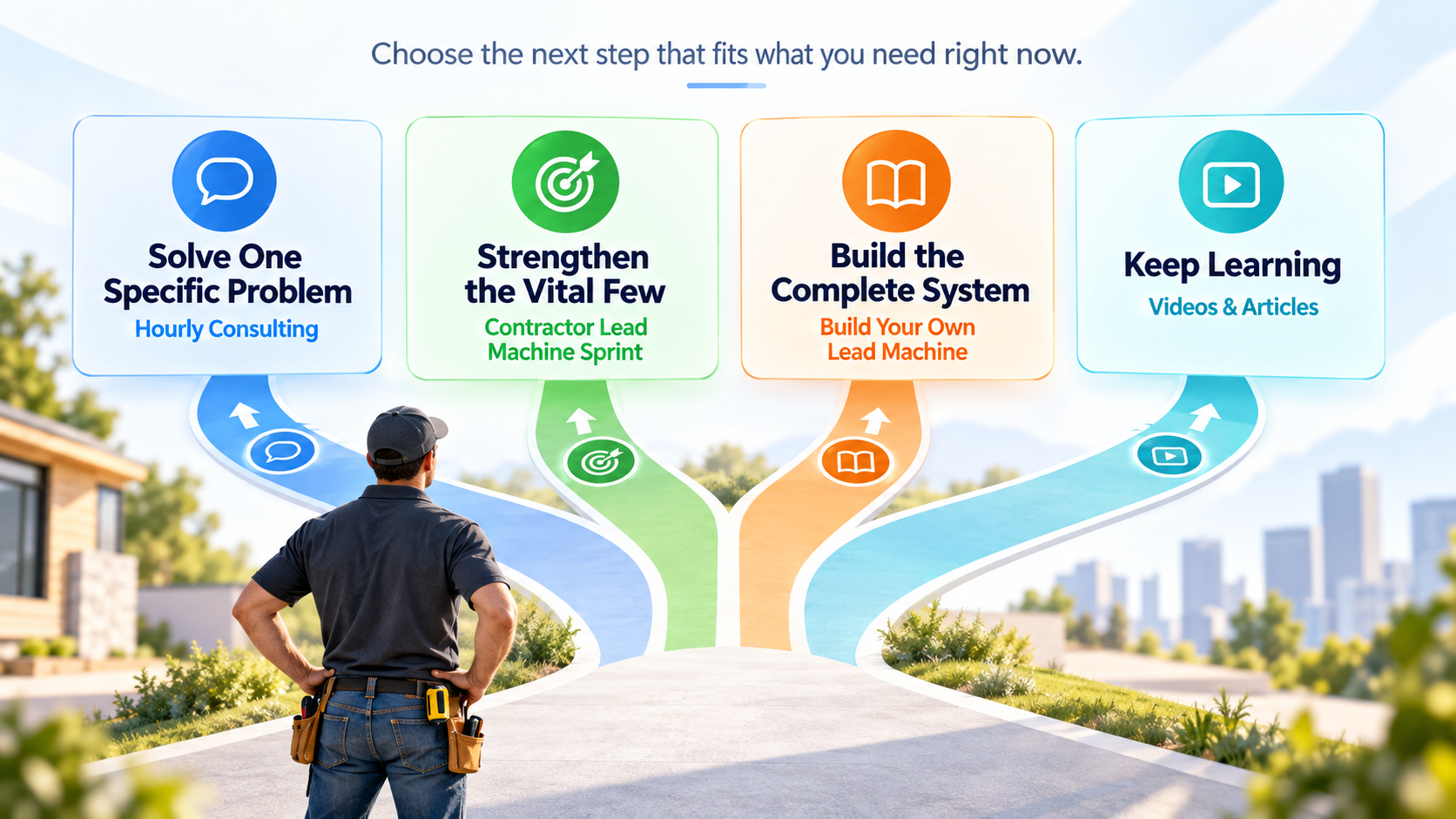
There are several ways to continue from here.
Have one specific sales or marketing problem you want help solving?
Learn About Hourly Consulting
Want me to evaluate your Lead Machine, identify the vital few improvements, and help you begin strengthening it?
Explore the Contractor Lead Machine Sprint
Want to learn how to build the complete system yourself?
Explore Build Your Own Lead Machine
Want to keep learning first?
Browse Videos & Articles
Start the Conversation
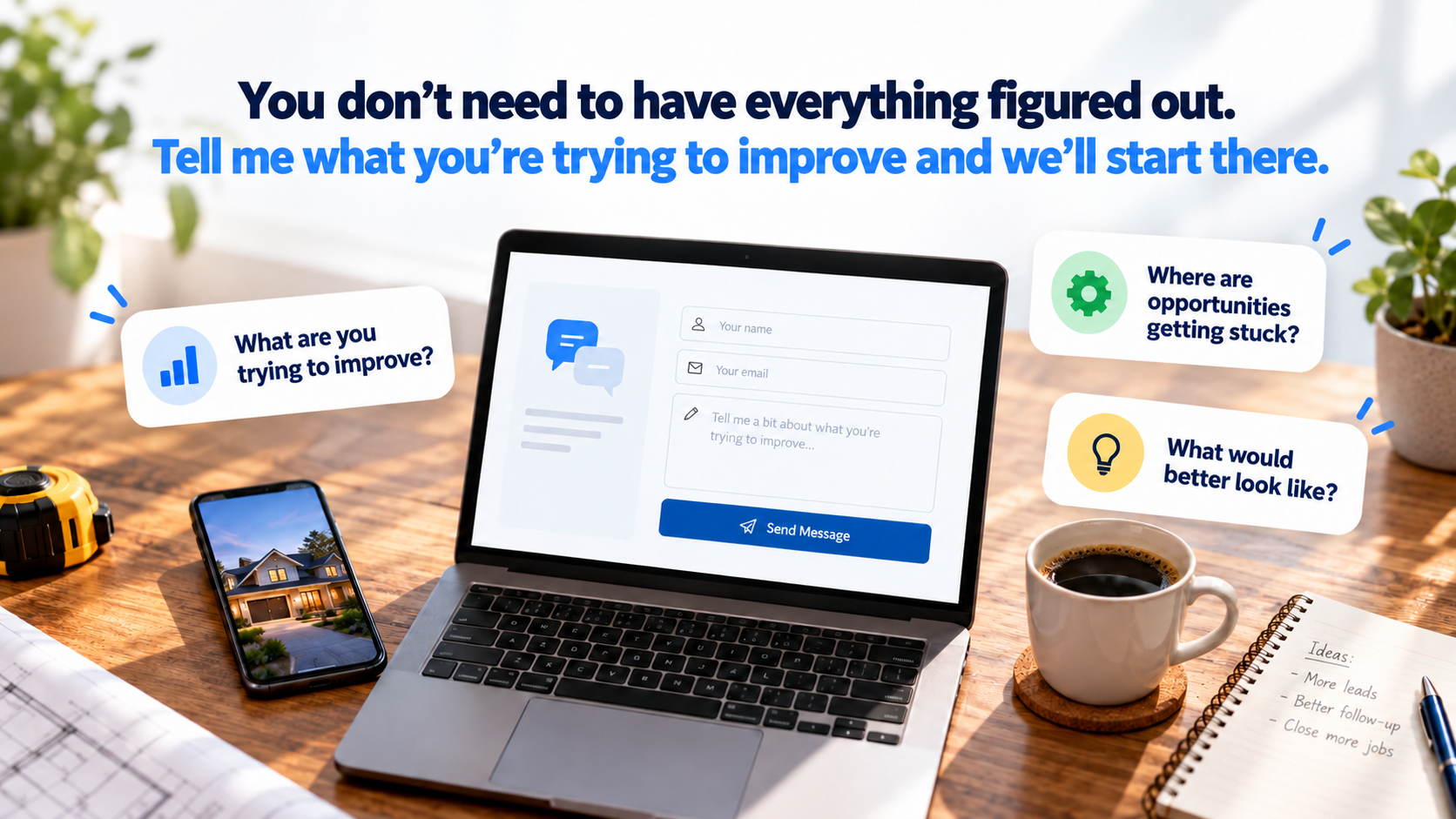
You do not need to know where your Lead Machine is broken before reaching out.
That is often part of the discovery process.
Tell me a little about your business, what you are trying to improve, or where opportunities seem to be getting stuck.
We’ll start there.