
Contractor Lead Machine Sprint

You probably don’t need to rebuild your entire sales and marketing operation.
You need to understand where opportunities are being lost, what deserves your attention first, and which improvements are most likely to create meaningful results.
That’s what the Contractor Lead Machine Sprint is designed to do.
Over four weeks, we’ll evaluate how your business generates, handles, follows up with, and converts opportunities.
Then we’ll identify the two or three gaps costing you the most, begin improving the highest-priority one, and build a practical 90-day roadmap around the few moves most likely to matter.
The goal is not to give you more things to do.
The goal is to help you focus on the right things.
You don’t need to fix everything
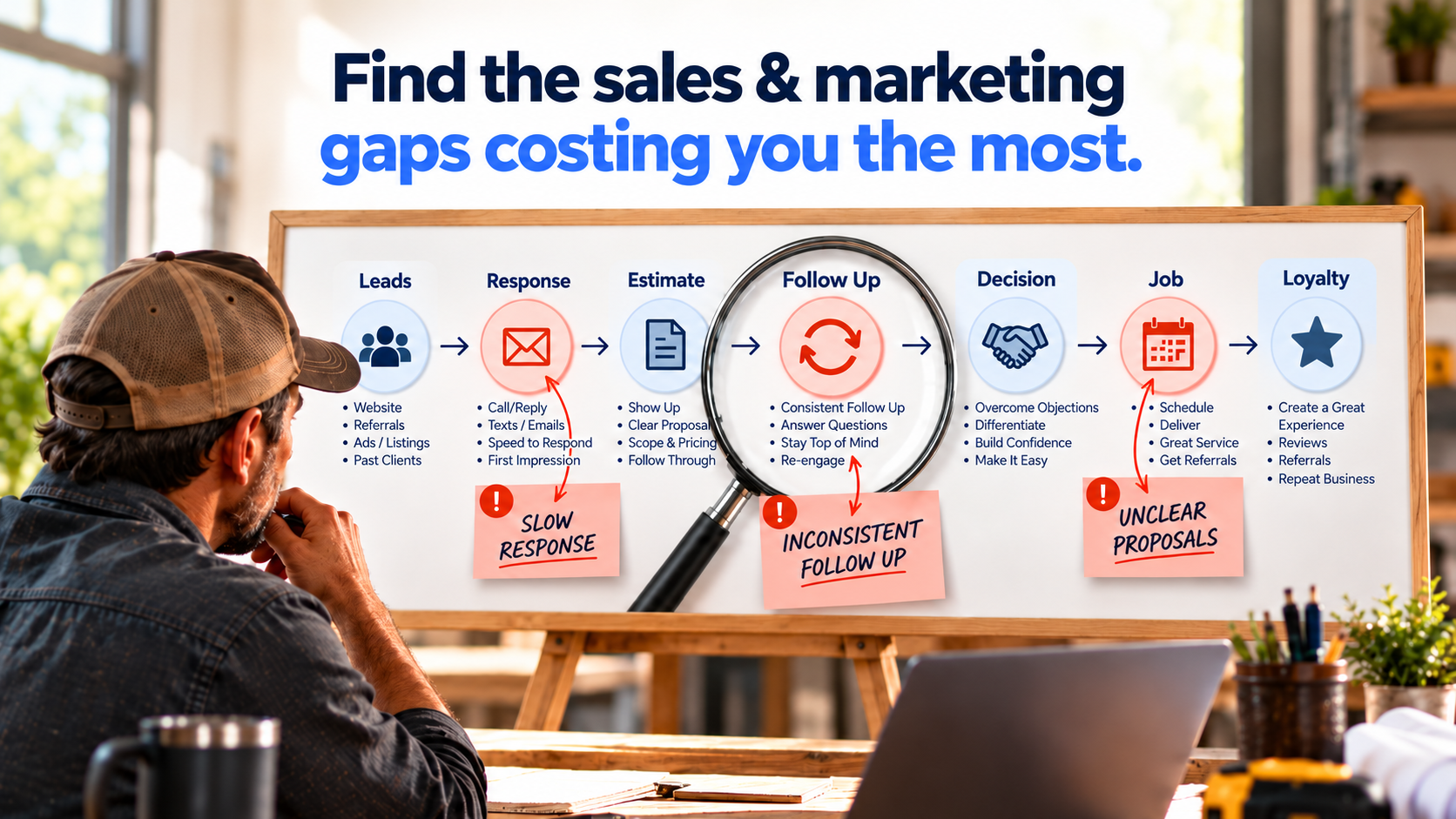
Contractors often know there are problems somewhere in the sales and marketing process.
But the symptoms can overlap.
Maybe:
Leads are going cold
Estimates are not converting
Follow-up is inconsistent
Nobody knows exactly what happened to older opportunities
Lead sources are expensive
Reviews and referrals are underused
Different people handle leads differently
Opportunities are tracked in several places
Nobody clearly owns the next step
The business gets busy and the process falls apart
The natural reaction is to start fixing whatever seems most obvious.
But the most obvious problem is not always the most important one.
And the lowest-scoring part of the business is not automatically the best place to start.
The Contractor Lead Machine Sprint uses a simple principle:
Evaluate broadly enough to understand the system. Prioritize narrowly enough to make the greatest improvement.
That means looking at the whole picture first, then concentrating on the vital few things that will produce the best results.
What is the contractor lead machine spring
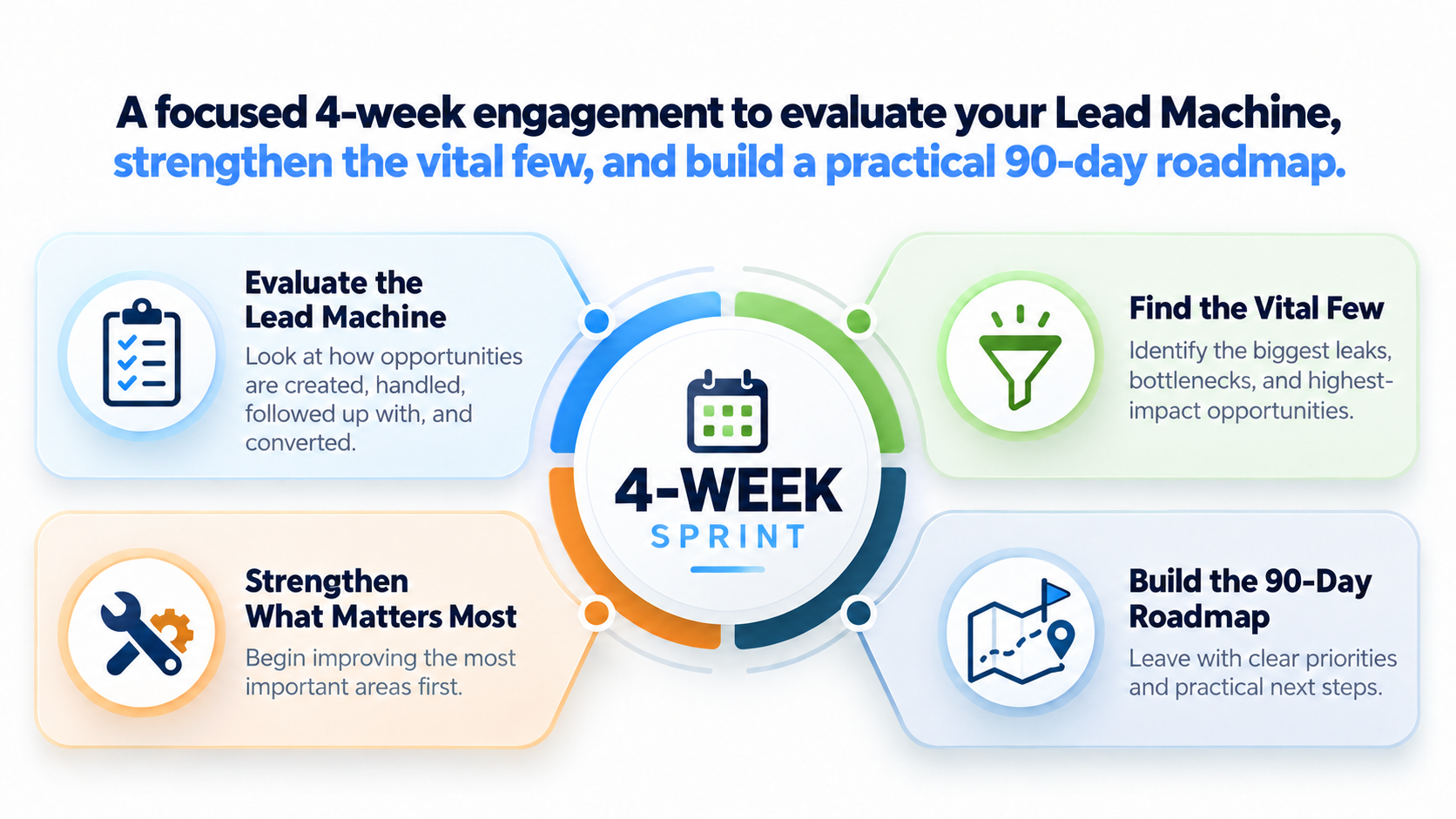
The Sprint is a focused four-week consulting engagement for small, local contractors who want to improve the way their business creates and converts opportunities.
We’ll examine how opportunities move through your business from the earliest stages of visibility and outreach through follow-up, decision-making, reviews, referrals, and repeat business.
The core promise is simple:
In four weeks, we’ll evaluate how your business generates, handles, follows up with, and converts opportunities, identify the two or three gaps costing you the most, begin improving the highest-priority one, and build a customized 90-day roadmap around the few moves most likely to create meaningful results.
This is not four weeks of theory.
We’ll diagnose the system, make decisions, begin implementing improvements, and leave you with a clear plan for what comes next.
Who the Sprint Is For
The Sprint may be a good fit if:
You are getting leads but are not confident they are being handled consistently
You think your follow-up could be stronger
You are not sure why estimates keep going cold
You rely heavily on paid or third-party lead sources
You do not have a clearly defined sales process
Several people touch leads but ownership is unclear
Your business relies heavily on memory, inboxes, notebooks, or scattered spreadsheets
You cannot easily tell which lead sources are producing actual jobs
You know reviews and referrals could be stronger
You feel like you are doing a lot of marketing but cannot clearly explain what is working
Your sales process works when things are calm but breaks down when business gets busy
You know opportunities are falling through somewhere, but you are not sure exactly where
You do not need to have a sophisticated CRM or a formal sales department.
In fact, many small contractors do just fine without them.
The purpose of the Sprint is to understand how your business actually works today and improve the parts that matter most.
The Four-Week Sprint
The Sprint follows a simple sequence:
Map → Fix → Strengthen → Roadmap
Each week has a specific job.
Week 1 — Map the Lead Machine
Before we decide what to fix, we need to understand what is actually happening.
We’ll map how opportunities currently move through your business.
That may include:
Lead sources
Website inquiries
Phone calls
Intake
Response time
Qualification
Appointment setting
Estimates
Proposals
Follow-up
Sales conversations
Tracking
CRM usage
Reviews
Referrals
Past-customer contact
Ownership
Measurement
We’ll establish a practical baseline and identify:
Strengths
Leaks
Unknowns
Inconsistencies
Missing ownership
Visibility gaps
Preliminary priorities
One of the most important distinctions we’ll make is the difference between:
The process you intended to have
The process people say they follow
The process that actually happens
The process you can reliably repeat
Those are not always the same thing.
By the end of Week 1, we should have a much clearer picture of how your Lead Machine is actually functioning.
Week 2 — Fix the Biggest Leak
Once we understand the system, we narrow the focus.
We’ll identify the most important confirmed leak and work through what is causing it.
That may involve problems such as:
Weak follow-up
Unclear ownership
Poor lead tracking
Slow response
Missing next actions
Inconsistent handoffs
Leads being forgotten when the business gets busy
Estimates being sent without a defined follow-up process
Then we build the smallest useful repair.
That means defining things such as:
What triggers the process
Who owns it
What action should happen
When it should happen
Where it gets recorded
What the next action is
What happens if the primary person is unavailable
How we know whether the change is working
The goal is not to create a giant operating manual.
The goal is to build something practical enough to use immediately.
Week 3 — Strengthen the Best Opportunity
Fixing leaks is only one side of improvement.
Sometimes the fastest gains come from strengthening something that is already working.
That may include:
Past customers
Reviews
Referrals
A productive lead source
A profitable service line
Strong local visibility
Customer proof
Existing content
Available team capacity
We’ll look for the best existing opportunity and determine whether it deserves more attention.
If the Week 2 repair still needs work, we may stay there instead.
The Sprint is not built around rigidly checking boxes.
We follow the evidence.
If deepening the primary repair creates more value than starting something new, that is where we focus.
Week 4 — Build Your Personalized 90-Day Roadmap
The final week turns what we learned into a practical implementation plan.
We’ll organize the findings into four categories:
Protect
What is already working and should not be disrupted?
Repair
What still needs to be fixed or stabilized?
Strengthen
What existing opportunity deserves more investment?
Postpone
What might be useful someday but should not distract you right now?
Then we’ll build the next 90 days around three phases:
Days 1–30 — Stabilize and Complete
Finish the most important repair and make sure the process can actually be followed.
Days 31–60 — Strengthen and Expand Carefully
Build on what is working without adding unnecessary complexity.
Days 61–90 — Measure, Refine, and Select the Next Layer
Review the evidence, refine the system, and decide what deserves attention next.
The roadmap is designed to answer:
What needs to happen
Who owns it
When it should happen
What it depends on
How progress will be measured
What success looks like
What could get in the way
What should happen if implementation slips
What should deliberately wait
You should finish the Sprint knowing not only what to improve, but what order to improve it in.
What You’ll Walk Away With
The exact outputs will depend on what we find, but the Sprint is designed to produce practical working tools such as:
A Current Lead Machine Map
A Baseline Snapshot
A Lead Machine Scorecard
Identified strengths
Confirmed leaks
Important unknowns
Priority findings
A working repair to the highest-priority problem
Clearer ownership and next actions
A simple measurement plan
Final recommendations
A personalized 90-day roadmap
A formal Not-Now list
The Not-Now list matters.
One of the fastest ways to create chaos is to treat every good idea as an immediate priority.
Part of the Sprint is deciding what not to work on yet.
What We Evaluate
The Contractor Lead Machine follows the homeowner’s journey through five stages.
Unawareness
How are future opportunities being created before a homeowner is actively shopping?
Awareness
When a need appears, can homeowners find you, trust you, and easily begin a conversation?
Consideration
How are trust, education, follow-up, and communication handled while the homeowner is comparing options and deciding what to do?
Decision
How does the business guide the homeowner through scope, price, concerns, timing, and the next step?
Loyalty
What happens after the job?
Are satisfied customers creating reviews, referrals, repeat business, testimonials, and future opportunities?
We also look underneath those five stages at the foundations that make the system reliable:
Clarity
Consistency
Ownership
Measurement
Resilience
Clear next actions
One usable source of truth
Backup coverage
Appropriate tools
Regular review
Processes that can survive normal business pressure
Why follow-up often deserves attention
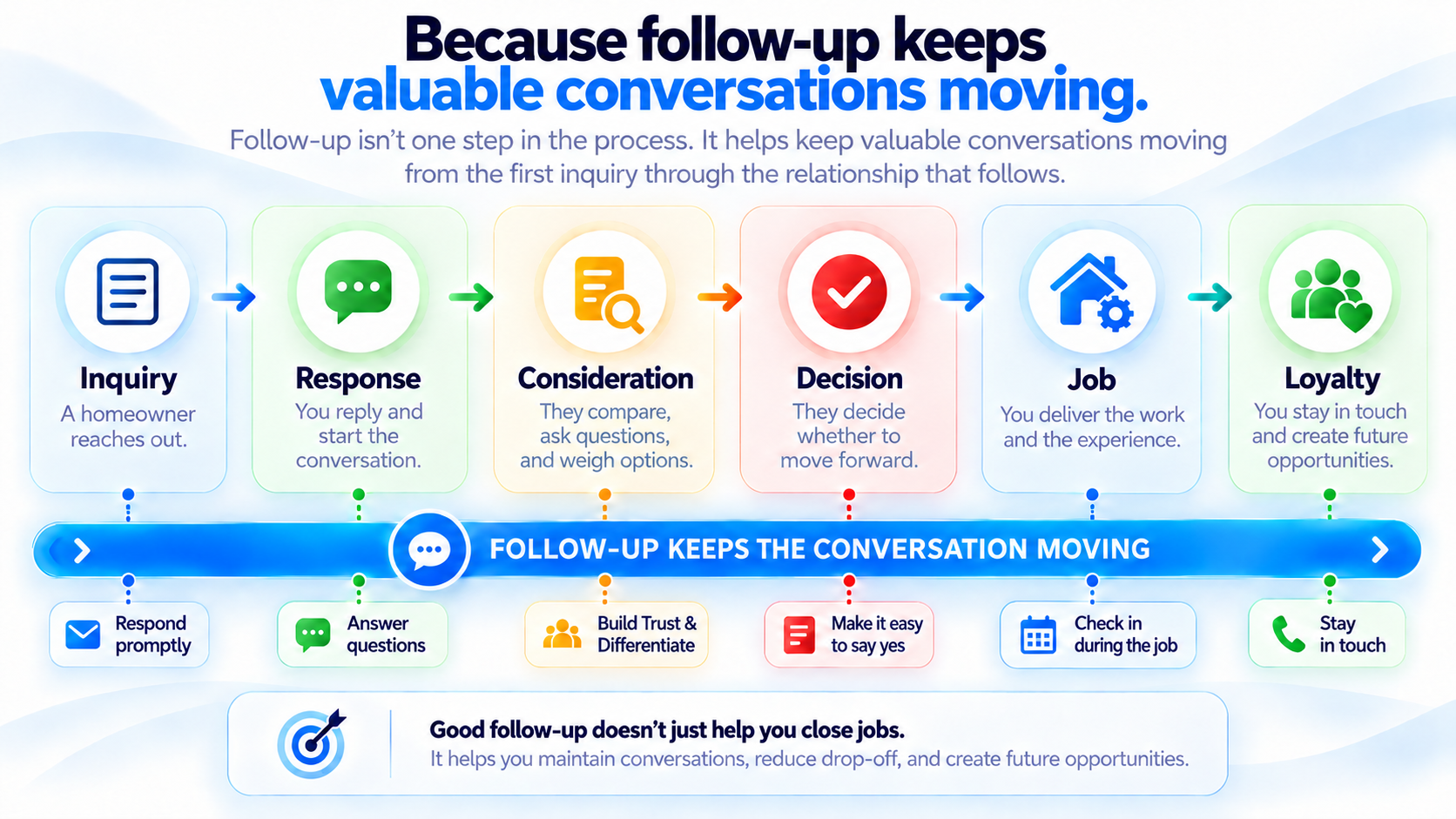
A good opportunity does not always become a job immediately.
Homeowners delay.
They compare.
They talk to spouses or family members.
They wait for financing.
They change priorities.
They get busy.
They go quiet.
That does not automatically mean the opportunity is dead.
One of the most common places businesses lose opportunities is between conversations.
Nobody defines the next action.
Nobody follows up at the right time.
Nobody records why the homeowner delayed.
The company gets busy.
The opportunity disappears.
Good follow-up is not about chasing people.
It is about understanding where the conversation stands and making sure legitimate opportunities are not forgotten simply because the homeowner was not ready on the first day.
More Leads May Not Be the First Answer
When growth slows down, contractors often assume they need more leads.
Sometimes they do.
But if the business is already losing good opportunities because of weak follow-up, poor tracking, unclear ownership, or an inconsistent sales processes, more leads may simply create more waste and more noise.
The Sprint helps determine which lever deserves attention first:
Create more opportunities.
or:
Convert more of the opportunities you already have.
Sometimes the answer is both.
But the order matters.
The Goal is a system you can actually use
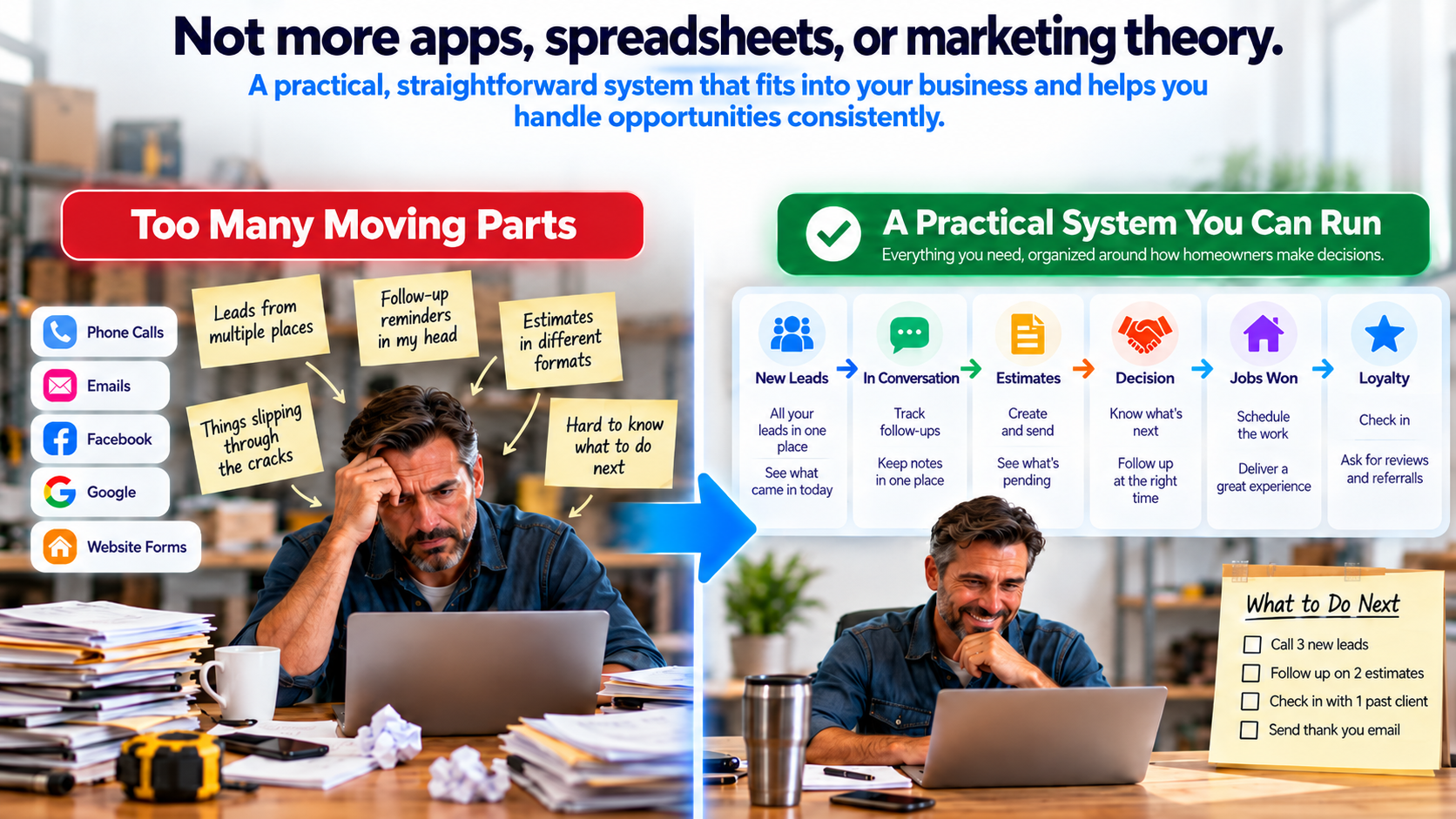
I am not interested in creating a sales and marketing plan that only works when everything is calm.
Contractors get busy.
People call out.
Projects run late.
Customers need attention.
Emergencies happen.
If a process disappears the moment the owner has a difficult week, it is not much of a system.
That is why the recommendations we make have to fit:
Your team
Your capacity
Your tools
Your current level of sophistication
The reality of how your business operates
The goal is not perfection.
The goal is reliability.
Why work with me?
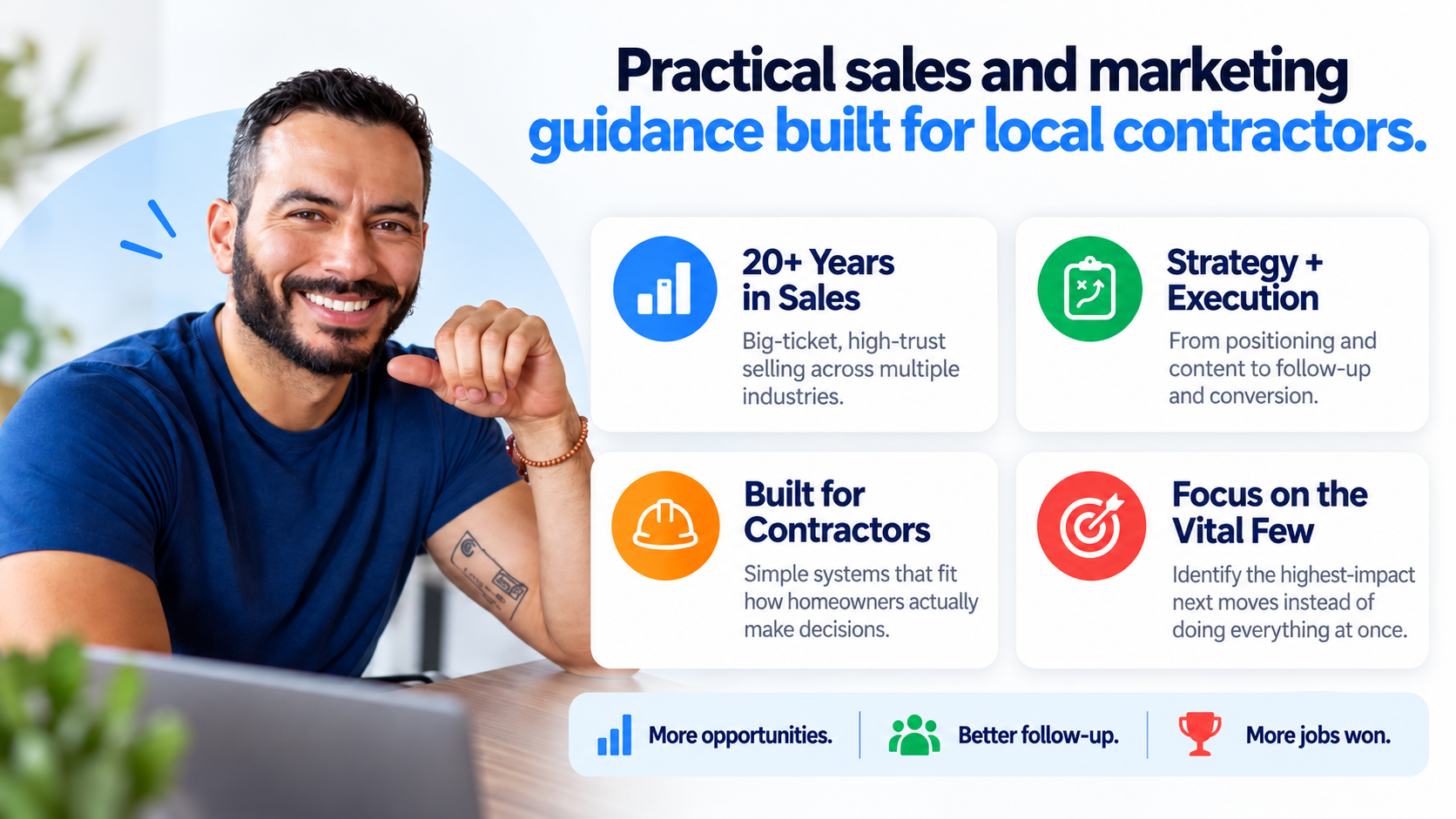
I’ve spent nearly 20 years selling big-ticket, high-consideration services across financial services, software, SaaS, digital marketing, and consulting.
Those experiences taught me how buyers behave when the decision matters.
They research.
They compare.
They hesitate.
They involve other people.
They worry about making the wrong choice.
They ask questions.
They disappear.
They come back.
And they respond better to clarity, trust, and good process than pressure.
That translates naturally to contractors.
Your customers are making important decisions about their homes, often involving thousands or tens of thousands of dollars.
My role is to bring the sales and marketing expertise I’ve developed over nearly two decades and apply it to the way your business actually creates, handles, and converts opportunities.
Investment
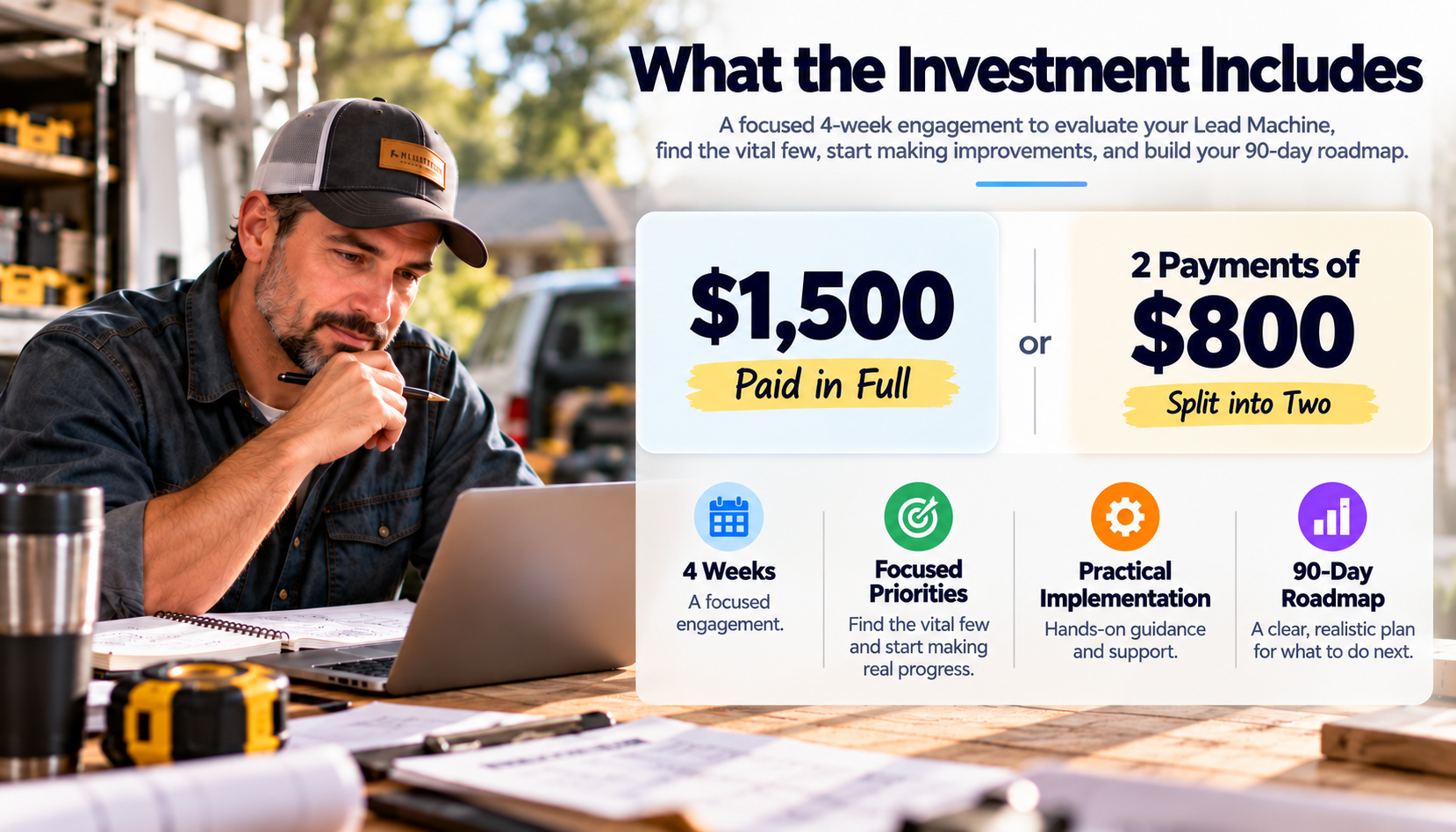
The first payment is due at enrollment.
The second payment is due before Session 3.
Enrollment is complete once the consulting agreement has been signed and the initial payment has been received.
When Hourly Consulting May Be a Better Fit
Not every contractor needs the full Sprint.
If you have one specific issue you want help with, want a second opinion, or simply want to work through a narrow problem, hourly consulting may be a better fit.
The Sprint makes more sense when the issue appears to involve multiple parts of the sales and marketing system or when you need a broader diagnosis before deciding what to improve.
Start the conversation
You do not need to know whether the Sprint is right for you before contacting me.
Tell me a little about your business, what you are trying to improve, or where you think opportunities may be getting lost.
If the Sprint is not the right fit, I’ll tell you.
We’ll start with the problem.